In plain English
- AI Overviews and AI Mode: Google's AI-written answers, shown with or above the usual list of links.
- Opt-out: a way for a publisher to refuse to have its content used for them.
- Default: the setting you get unless you change it, like the search engine a phone or browser comes with.
- robots.txt: a file on a website that tells automated crawlers which pages they may read. The new shared signal is a line in that file that tells AI companies not to train on the site.
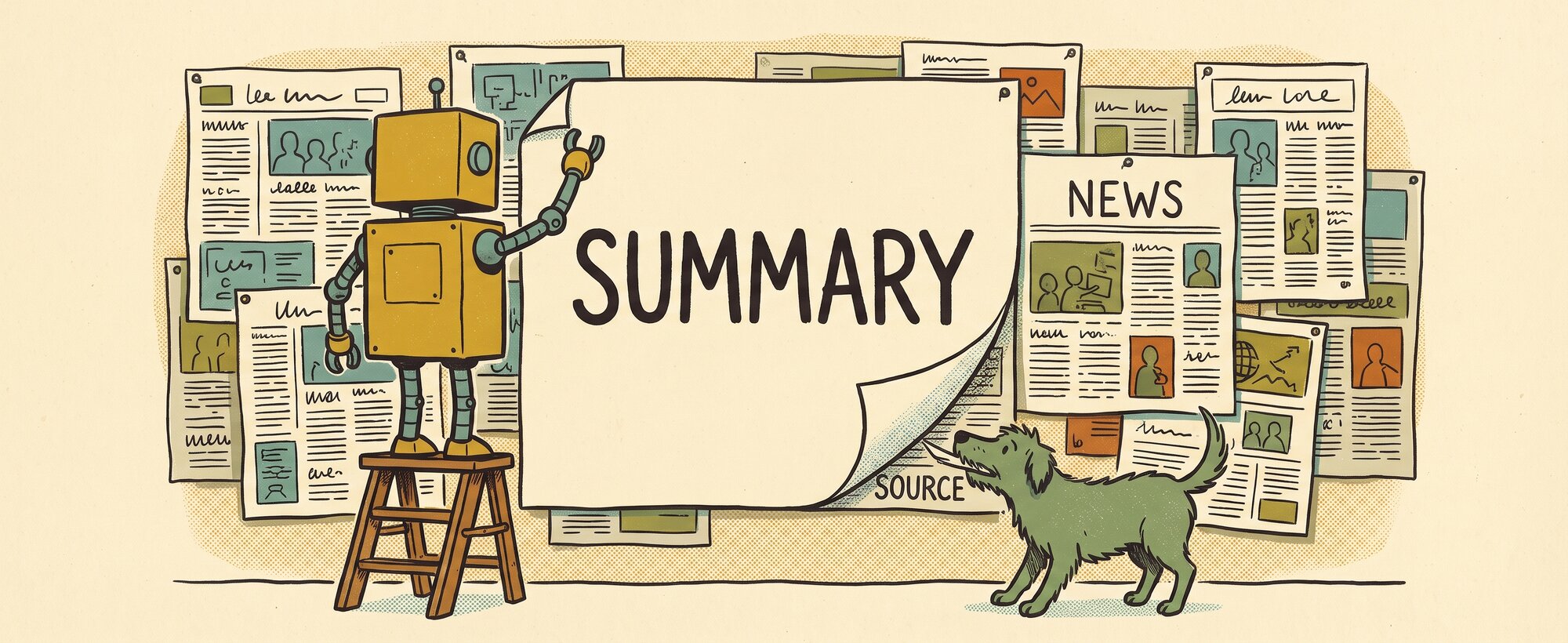
You run a small bike repair shop, and you spend a weekend writing a guide to fixing a slow puncture for your website. A month later, people who search for that fix see Google's AI summary of your guide at the top of the page, and they may not need to visit your site. Can you keep your guide out of that summary, and out of AI training too?
Since 31 August a setting in Google Search Console can keep your guide out of that summary, and Google says it won't affect your place in the ordinary results. But Google uses your guide in the summary unless you find the setting and change it, and the setting covers only Google's search summaries. Search Console is Google's free tool for website owners, and whoever manages your site's account there, you or your web agency, can change the setting. Keeping your guide out of AI training is done separately, with a robots.txt rule for each company's crawler. A shared rule for all of them won't work until 2027.
In the UK, the Competition and Markets Authority required Google to give publishers effective tools to stop their content being used in AI features in search. Google began testing the Search Console setting with some UK sites on 3 June and rolled it out to every website worldwide on 31 August. Sites that opt out "will not receive traffic or impressions" from Google's AI features, and Google says the setting "will not be used as a ranking signal" for the ordinary results.
On 8 October Turkey's competition authority, the Rekabet Kurumu, ordered Google to set terms that reflect the economic value of news publishers' content and to let them decide whether it is used in AI Overviews and AI Mode, separately from how they are indexed and shown in Google's other services. On 2 November it announced an investigation into Google's AI Overviews and AI Mode. The European Commission opened a formal antitrust investigation on 9 December 2025 into whether Google broke EU competition rules by using publishers' content for AI.
On 30 October Google announced that it plans to support a shared AI training control in robots.txt, the file that lists which pages crawlers may read. Microsoft and OpenAI announced the same plan, and the draft standard behind it was written by Kevin Kelley at Anthropic.
Under the draft, a site opts out by adding a separate group to robots.txt headed User-Agent: __usage_ai-training, and whoever looks after your site can add it. A rule written for every crawler, User-Agent: *, doesn't count, so a site that blocks all crawlers today has still not opted out under the new signal. Google will read the opt-out as a block on Google-Extended, its existing training control, which covers training and answers in the Gemini app, not AI Overviews. Google aims to support it in 2027. Neither Google's post nor the draft standard says anything about content already collected or about payment.
On LinkedIn, Matt Martelli, who designs and builds AI agent workflows, described a roofer's nephew who adds that kind of line over a weekend, and Muhammad Noman Raza, an SEO specialist, pointed out that the training line won't take a site out of AI answers.
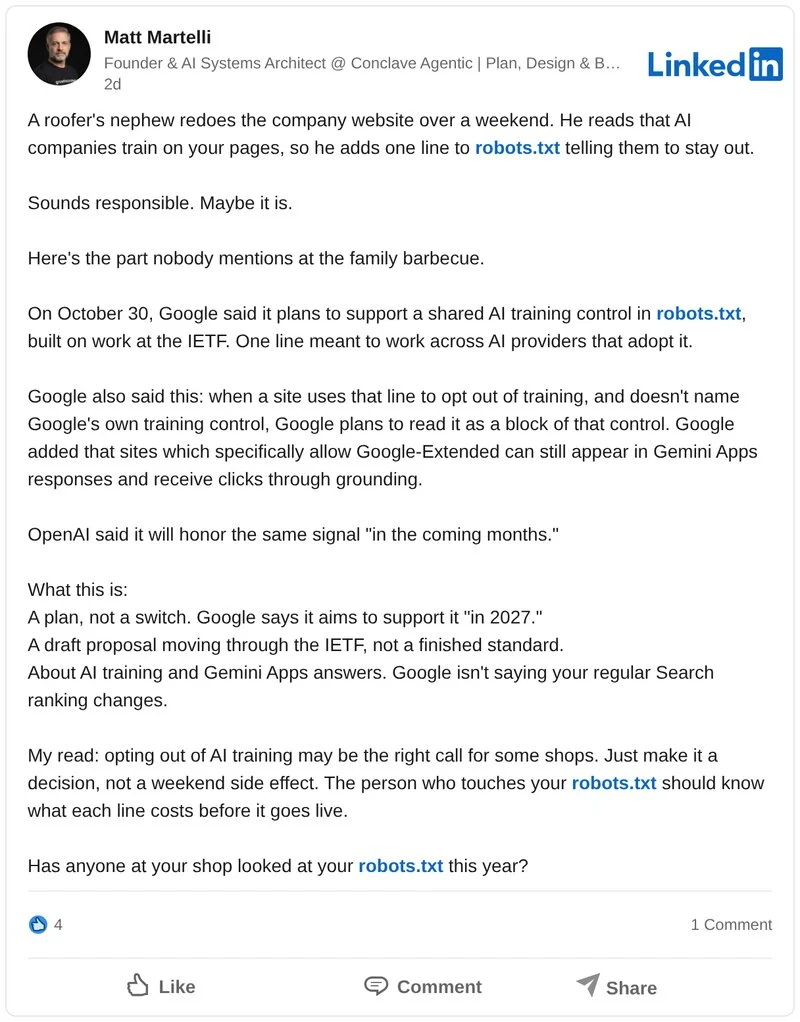 Matt Martelli, designs and builds AI agent workflows · LinkedIn
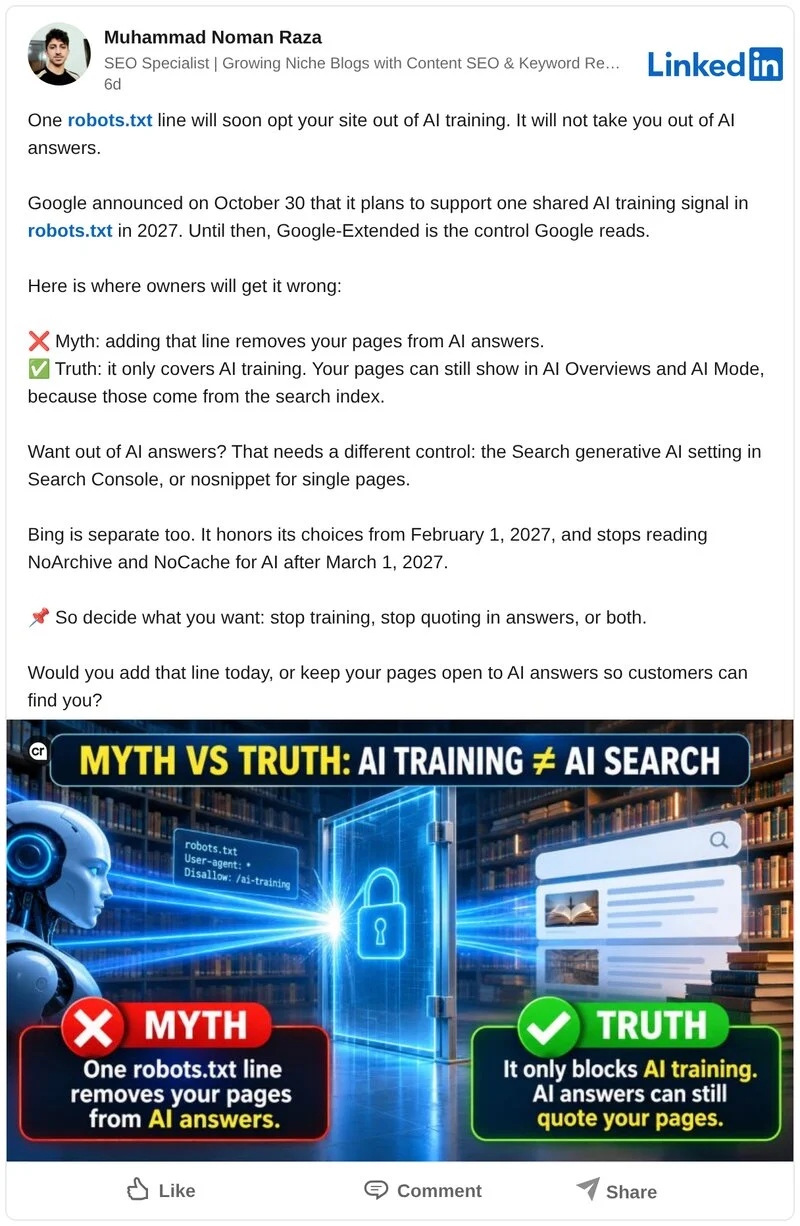 Muhammad Noman Raza, SEO specialist · LinkedIn
My concern is that people aren't going to own their own voice anymore. If all people are getting from search results are AI Overviews and not actual written text from people, they only ever see results filtered through an AI Overview, with none of the individuality that makes humans human, or the special takes that media outlets might have, and they won't likely click past it to the site where the actual information is. The flip side is that if publishers don't like Google showing their results, they could just not use Google. But the trouble is, everyone uses Google. Google has its own operating system, and it is the default search engine on many things. So people don't know any better, which makes it even worse, because you have ignorant people, in the best sense of that word, being misinformed.
I don't want to go demonising tech companies. They've got enough working for them and against them.
The European Broadcasting Union measured how often chat assistants get news questions wrong in a study published in October 2025, and it did not test Google's AI Overviews. Journalists evaluated more than 3,000 responses from ChatGPT, Copilot, Gemini and Perplexity to news questions. Forty-five percent of the answers had at least one significant issue, and 31 percent showed serious sourcing problems: missing, misleading or incorrect attributions.
It goes back to critical thinking and verifying sources.
Publishers can build a list of readers who come to them directly, such as newsletter subscribers or paying members. They can make each AI choice on purpose: the Search Console setting for Google's AI summaries, Google-Extended and each AI company's own crawler rules for training, and the shared robots.txt group once it is supported in 2027. A site that changes none of these settings is still used in Google's AI summaries and can still be used for AI training.
If you run a small business rather than a publication, Google's AI summaries are less of an issue for you than they are for publishers. Google is still king for search, so rather than opt out at all, I would keep your site in Google's AI summaries, but make sure the information is accurate. If an AI Overview gets something about your business wrong, Google's help page says to click the thumbs-down on the overview, then Report a problem, choose a category and describe what's wrong. Google says the feedback helps it improve AI Overviews, but it doesn't promise to change the answer.
Readers can click through from an AI summary to the source it names, and check any number, quote or date that matters against the original. They can subscribe directly to a few sources they trust.
Made-up example for illustration. The village, the people and the article are invented.
Check the summary
A made-up summary, written the way an AI summary reads, beside the story it summarises. Decide whether you trust each claim, then click or tap it to check.
Summary
Click or tap a claim to check it.
-
Correct. The article says exactly this, in the passage now highlighted.
-
Wrong number. The article says £48,000 a year. £31,000 is what the clerk said the council's reserves would fall to.
-
Out of date. The article says the start was first given as 6 April and then moved to 4 May. The summary kept the old date.
-
Wrong source. Councillor Tamsin Okoro said this. Councillor Vane opposed the bus.
-
Correct. The article says the trial will be reviewed in March next year.
Article
Dunmarrow council backs new evening bus route
Dunmarrow Parish Council voted 7 to 2 on Tuesday 10 March to fund a new evening bus service linking the village to Pellbrook Junction station. Matching passage in the article. The route, numbered 14, will run from 6 pm to 11 pm, Monday to Saturday. The start date was first given as 6 April, but Matching passage in the article. the council has moved it to 4 May.
Matching passage in the article. The council will pay £48,000 a year for a two-year trial. Councillor Tamsin Okoro, who proposed the motion, said: Matching passage in the article. "Young people and shift workers have had no way home after six." Councillor Gerald Vane, who opposed it, said the money would be better spent on repairing the Mill Lane footpath. "I don't think enough people will use the bus," he said.
The service replaces the evening route 9, which was cut in 2022. Ticket prices have not been set. Matching passage in the article. The trial will be reviewed in March next year. The funding comes from the council's reserves, which the clerk said would fall to £31,000.
Invented for this page. It is not a real news story.
Nothing checked yet.
2 of 5 claims are correct. 3 had an error: one in a number, one in who said a quote, and one in a date.
This page sends nothing anywhere. Your clicks stay in your browser.
*Kit Library members can copy a note to send their web agency about both settings, with a monthly check of what Google says about their business and how to report a wrong AI Overview.*
Updated 5 November 2026: Google's Search Console setting for AI Overviews and AI Mode has been available to every website since 31 August and is not used for ordinary ranking, so this post no longer says opting out costs search visibility. Added the shared AI training rule for robots.txt announced on 30 October.