In plain English
- Public body: a government organisation, from a ministry to a town hall.
- ENS (Esquema Nacional de Seguridad): Spain's mandatory security standard for public bodies.
- NIS2: the EU law that sets security duties for essential services and public administrations. Each country has to write it into its own law.
- CCN and CCN-CERT: Spain's national cryptology centre and its incident response team for the public sector.
- Cyber Resilience Act: the EU law that makes makers of digital products report flaws that are being exploited.
- Security operations centre (SOC): a team that watches a network for attacks. A shared or virtual one serves several organisations.
- Project Glasswing: Anthropic's project, with about 50 partners, that uses AI to find flaws in widely used software.
- MS-ISAC: a US information-sharing and security service for state and local government.
- Patch: the fix for a flaw. It only protects you once it's installed.
You need a document from your town hall, so you log in to its website with your national ID. It's how you do most things now, and if there's a flaw somewhere in that site, an AI model could find it quickly and someone would have to fix it. Who is that, and who pays for the people to do it?
This series started with one of those flaws. In part 1, Anthropic's Claude pulled vote counts from a Georgia state website using an access token the site gave to any visitor. Part 2 looked at how fast AI models now find flaws, and how fixing them still depends on suppliers, approvals and people.
When this series started, I asked: So there's no one responsible for plugging those gaps or sourcing people? Is that where the gap is? The rules answer only part of it, because under them each body is responsible for its own systems and nothing says who pays for the fix or who supplies the people at a small body.
Spain's Esquema Nacional de Seguridad, the security standard every public body has to meet, makes each administration responsible for its own security policy and controls. The national team, CCN-CERT, supports them and helps with incidents. At EU level, the NIS2 directive covers central government and leaves local government for each country to decide, and Spain still hasn't passed its own NIS2 law. In July the European Commission took Spain to the EU Court of Justice over it, along with Ireland, France and the Netherlands. The bill never reached the Cortes, Spain's parliament, before the Cortes were dissolved on 5 October for the 29 November general election, so it starts again under the next government.
The UK puts it the same way. Its Government Cyber Action Plan says departments "remain accountable for their own cyber security and resilience", and the Local Government Association says councils are "largely excluded" from the new cyber bill.
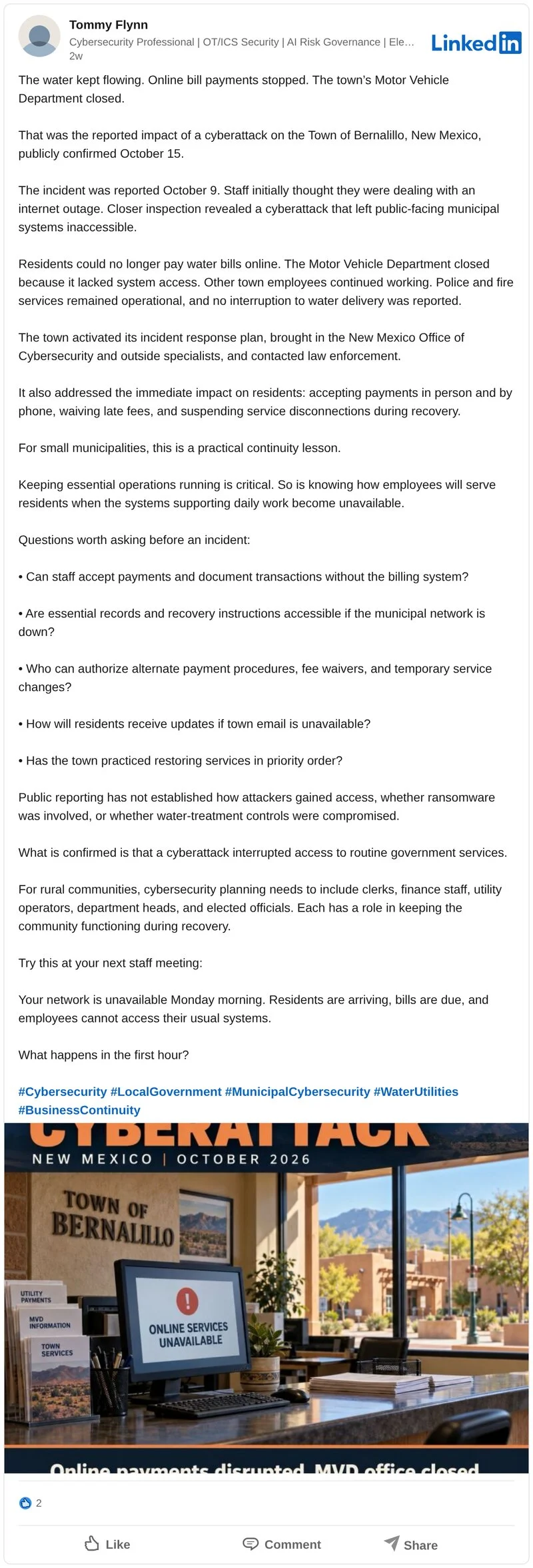
Small public bodies are already being hit. In October the Town of Bernalillo in New Mexico confirmed a cyberattack, which reportedly stopped online bill payments and closed its Motor Vehicle Department, as Tommy Flynn, a cybersecurity professional, described on LinkedIn.
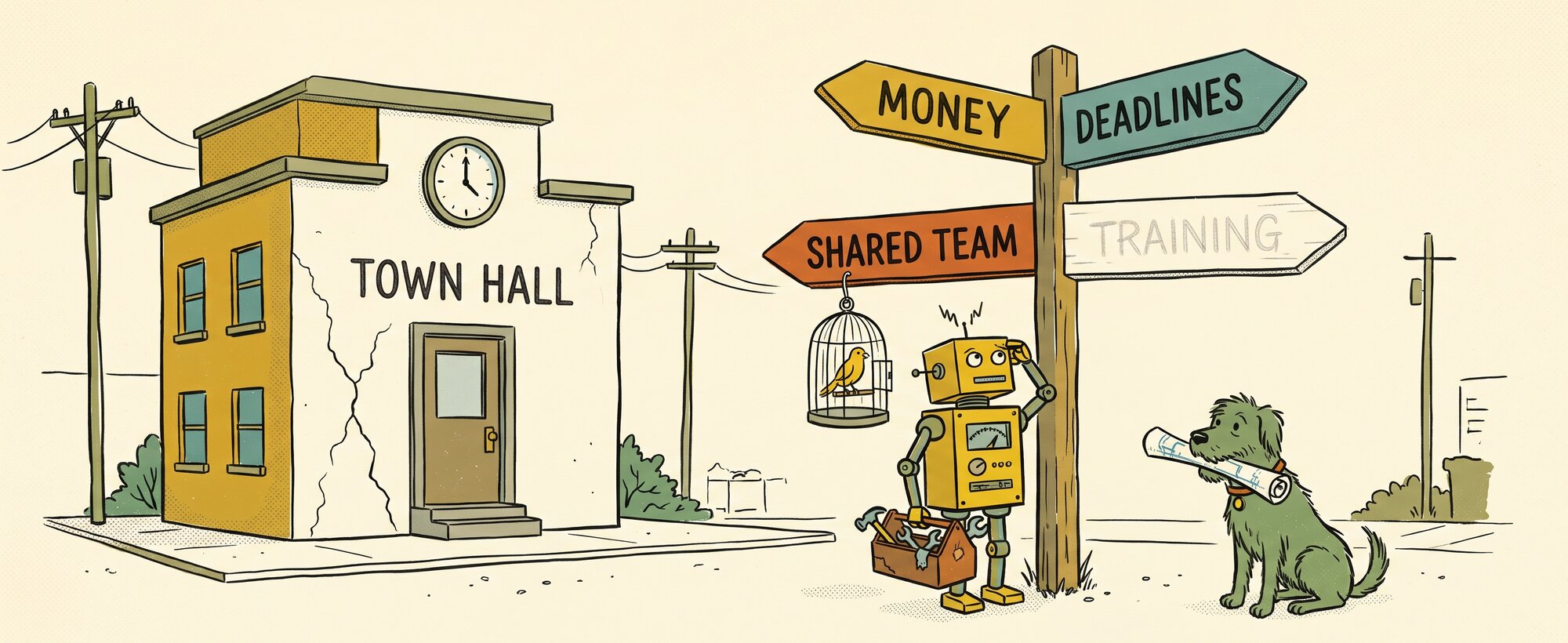
Help for public bodies does exist, and most of it is money. The US set up a $1 billion, four-year grant programme for state and local government, but its funding authority lapsed on 30 September and hasn't been renewed. England's Local Digital programme reports more than £28 million for councils since 2020. Even so, Europe's council body, the CEMR, says smaller municipalities "lack the resources" for strong cybersecurity.
Some rules set deadlines for fixing flaws, but they mostly bind central government and software makers. The US cyber agency CISA gives federal agencies three days to fix some of the flaws on its exploited list, and the deadline doesn't apply to state or local government. In the EU, the Cyber Resilience Act makes the makers of digital products report flaws that are being exploited within 24 hours. It puts no duty on the council that uses the product, even though the council still has to install the fix.
Shared security teams are the closest anyone comes to supplying people. In 2021 a pilot in Valencia province shared a virtual security operations centre between ten small and medium municipalities, using a tool from Spain's national cryptology centre, the CCN. The CCN also publishes lighter compliance profiles for town halls under 5,000 and 20,000 inhabitants and a 75-hour online course for organisations that can't reach compliance on their own. In its own words, the standard is "de difícil cumplimiento de manera individualizada" for the smallest entities: hard to meet alone. The US had a shared service for state and local government too, MS-ISAC, until it lost its federal funding in 2025 and started charging.
Training is where the help runs out. In the US and Spanish sources behind this post, there's no scheme that trains cyber staff and places them in small local administrations. The nearest is a foundation that Accenture, Dragos and the SANS Institute announced on 20 October to give free security help to small US and Canadian utilities. It covers only utilities, and enrolment hasn't opened yet.
Projects like Anthropic's Glasswing work on big tech and operating system level security, and that's one prong of what's needed. It's got to be a many-pronged approach from different sides. There's education and maintenance and systems running that need to be looked at as well, and that's a human factor. I would like to see people trained up and get help to fix these things.
So who fixes the flaws AI finds? By law, the body that runs the system, and small bodies in particular may not have the money or the people to do it. We need to come together as a society to implement. But how can we implement at this kind of scale? The one thing I'd start with is training for the staff who already look after a town hall's systems. For readers, the place to begin is finding out who is responsible for the systems you depend on, so ask your employer, your IT supplier or your town hall who patches those systems and how fast. Then ask who decides when, and whether they belong to a shared security team or a training scheme, because if nobody can answer, that body may have no one ready to fix a flaw when one is found.
*Members can copy the questions for a town hall or IT supplier as an email and a checklist.*