In plain English
A skill is a saved set of instructions, with any supporting files, that an AI loads when a job needs it. An agent is an AI model working in a loop with tools, deciding for itself which steps to take and in what order. Context is everything the model has in front of it for one job: your request, the material you give it, and any skill it has loaded. The context window is the amount of text the model can read at one time. Training is what the model learned before you ever used it, and it is separate from the context you give it.
Google is turning Gems into skills, starting in November for personal accounts. If you have Gems, they will be recreated as skills either by Google or by you, so this is a good time to learn what a skill is for.
The client teams I work with have heard "agentic, agentic, agentic" and "agent, agent, agents." Then a team says "I don't know what to do with this great big anything engine."
I tell them to start with something really big, long or arduous, and break it into a set of simple steps that can be automated. That's the skill. Once a team sees how a job breaks into reusable snippets, they can put a virtual agent in charge of running specific sets of them. In a loose sense, a conversation with an LLM is already a conversation with an agent, either a general one or a specialised one.
The client teams I work with have heard "agentic, agentic, agentic" and "agent, agent, agents." Then a team says "I don't know what to do with this great big anything engine."
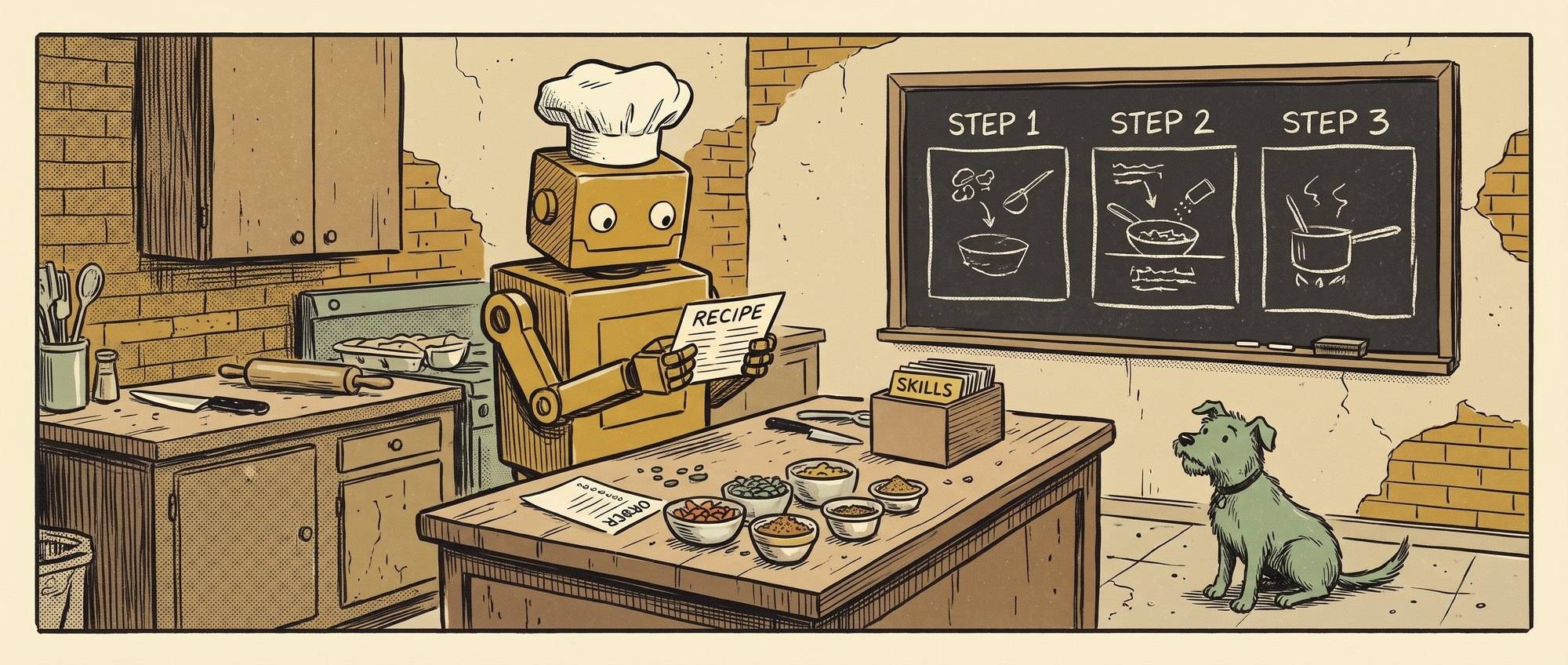
The order is skills, then agents, then context. The skill is the recipe card: here is the recipe for key lime pie. And the agent is a chef. The recipe card is reusable instructions, plus any supporting files, loaded when a job needs them. The chef is a model working in a loop with tools, in charge of running specific sets of skills. Context is everything on the counter for this particular job, including your request, the material you give the model, and any skill it has loaded. Anthropic's documentation says that when a request matches a skill's description, Claude reads the SKILL.md file and "only then does this content enter the context window." Until then, only the skill's name and description are in the context window.
Anthropic's "Building effective agents" guide, published in December 2024, separates workflows, where LLMs and tools follow "predefined code paths," from agents, which it describes as "systems where LLMs dynamically direct their own processes and tool usage." In practice, it says, agents are "just LLMs using tools based on environmental feedback in a loop."
Google describes skills as "reusable custom instructions" that Gemini applies automatically when they are relevant. It says they use the SKILL.md format and that skills made on other platforms can be copied in. Anthropic's Agent Skills use a file with the same name, and its documentation says skills "load on demand, so you don't have to repeat the same guidance across conversations." Google's two accounts of 17 November 2026 differ for personal accounts: its blog says Gems move into the Settings panel of the Gemini app, where they can still be created, edited and used, while its support page says Gems become read-only that day and are removed on 17 December. Google's help page says the transition reaches work and school accounts in 2027. For business and enterprise accounts, Gems stop working no sooner than 1 March 2027, and any left in the Gemini app are converted to draft skills. Skills started rolling out in the Gemini app on 13 October; the launch to Workspace apps is delayed.
The 3 October post gave a shorter version: "The context is the ingredients on the counter, the skill is the recipe card, and the model is the cook." That was a simplification. The cook is more accurately the agent, the model working with tools in a loop, and the list for context was too short: your request and any loaded skill are on the counter too, alongside the ingredients. In conversation I have also described context as a culinary school, and that needs the same correction. A culinary school describes training, which is what the model learned before you first used it, and training is separate from context.
If you already have Gems, Google says it will recreate them as skills when it removes Gems, and you can recreate them yourself sooner.
InteractiveBreak a big task into skills
Mark each step: does it go the same way every time, or does it need a person?
Steps to write as skills
Keep with a person for now
Write each of these steps down as a skill that does one thing very well. Once you have a few, an agent can be put in charge of running them.
Nothing you type leaves this page.
AI you can actually use, every week
Signal Over Noise is a weekly newsletter cutting through the AI hype.