
TL;DR
- Pasting a chatbot’s answer straight back to whoever asked the question turns one person’s question into a reading job for two, since they must now judge relevance and truth without knowing the prompt.
- Developer Niklas Gruhn named the pattern “meat proxy” and proposed the fix: read the output, validate it, then write a reply in your own words.
- Two practical options replace the paste: put it in two or three sentences of your own, or hand over the question and the prompt so the other person can ask directly.
- There is a limit: forwarding raw output is correct when someone asked to see exactly what the model said, or when the output itself is the subject of discussion.
In plain English
“Meat proxy” is Gruhn’s term for a human sitting between a question and a machine, relaying messages and adding nothing on the way through. The counter-argument runs through Larry Wall’s three programmer virtues, written into a Perl manual in 1996: Laziness, defined as going to great effort to reduce overall energy expenditure; Impatience, the anger you feel when the computer is being lazy; and Hubris, caring enough that others won’t want to say bad things about what you made. The word “overall” carries the argument, because a relayed answer saves the sender’s time and spends more of everyone else’s.
The post also disputes the label “artificial intelligence”, following a six-word post from Jack Dorsey, and describes the technology as automation at scale that no longer needs a programmer to set it up. It calls this hyperautomation, a word Gartner coined in 2019 for stacking enterprise automation software into one system, used here in the simpler sense of a machine doing what you told it very fast. The naming changes what you do with the output: an answer looks like something you forward, and a draft looks like something you check.
Picture this: someone asks you a question at work. You don’t know the answer, so you ask a chatbot. Then you paste what it said back to the person who asked, with “here’s what ChatGPT said” on the front.
Boy oh boy, if you think that’s actually helping — think again.
Think about what you’ve actually handed over. The other person now has to read a long answer, work out which parts are relevant, and decide whether any of it is true — and they have to do all of that without knowing what you asked, or why you thought this was the right response. You’ve taken a question that one person had and turned it into a reading job for two. That’s negative work being done.
A developer called Niklas Gruhn wrote this up last Monday and gave it a name. He calls it being a meat proxy — a human standing in the middle, passing messages between someone with a question and a machine, adding nothing on the way through.
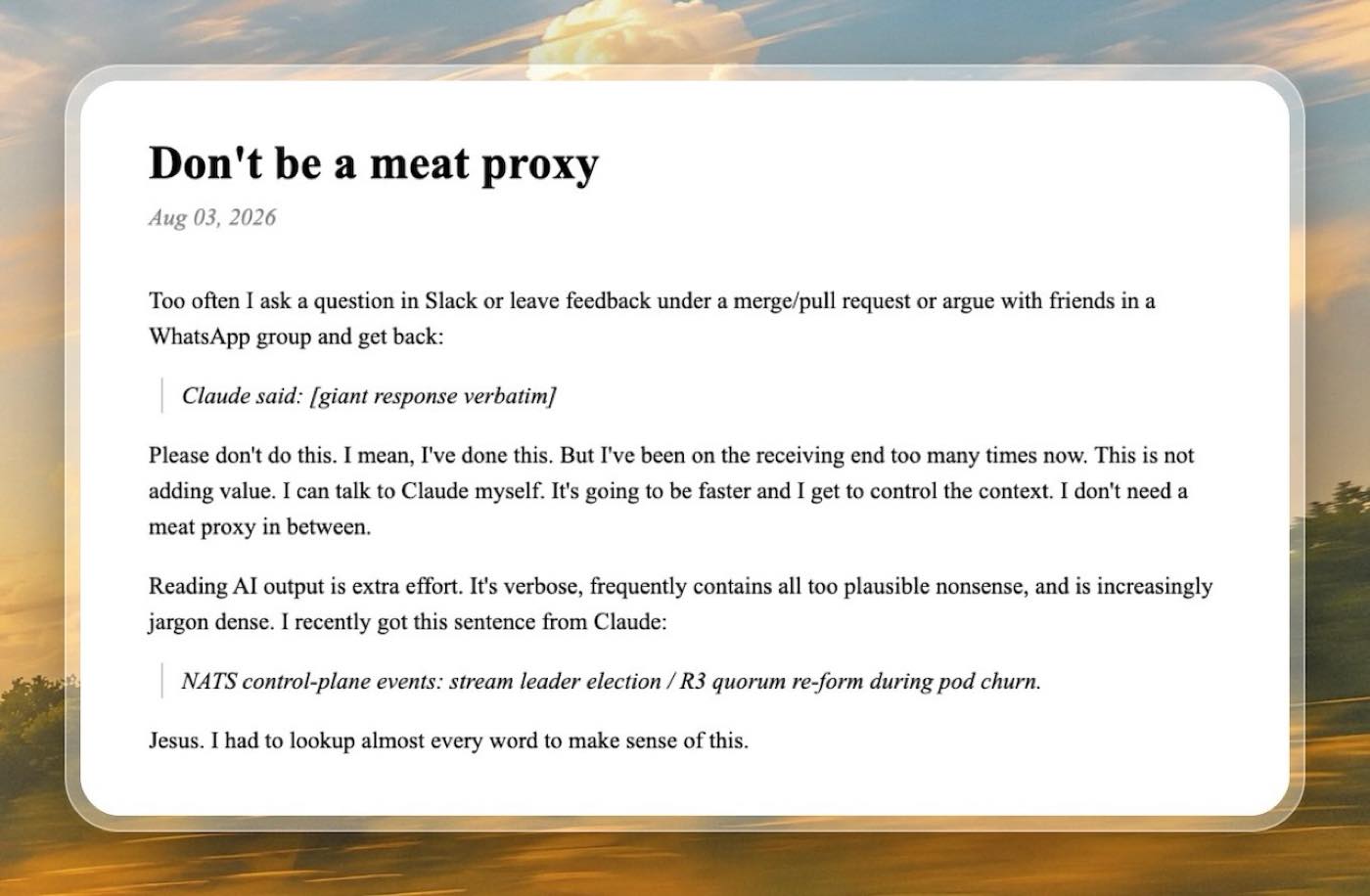
His version happens in Slack and in code reviews.
“Please don’t do this. I mean, I’ve done this. But I’ve been on the receiving end too many times now. This is not adding value. I can talk to Claude myself. It’s going to be faster and I get to control the context. I don’t need a meat proxy in between.”
And his fix:
“By all means, prompt AI. But don’t just relay the output. Read it, understand it, validate it, and then write a response in your own words (a decent certificate that you’ve done the prior steps). Making that effort is value you can add.”
You already know how this works, because you did it at school on your first book report. A book report is not the book. Nobody ever believed the point of a book report was to produce a summary — the point was that you couldn’t write one without having read it. Putting something in your own words, re-contextualising it for whoever has to read it next, is the work.
At the very, very least, when you rephrase what the machine gave you, you have ingested some part of what you looked up. It’s fine to use AI as a tool and to prompt it. Just make sure you’re pulling out something genuine at the same time.
So why does anybody do it?
Because collectively we have called it ‘intelligence’.
Jack Dorsey posted six words on Thursday: “artificial intelligence” is the worst descriptor. And he’s right. But if it isn’t ‘artificial intelligence’, then what exactly is it?

AI is, at its most base level, automation at scale. Getting a machine to do a job you’d otherwise do by hand, over and over, without you, and that has existed for decades. What changed is that it stopped needing a programmer.
Programmers have always known this, incidentally, and the good ones say so openly. An unwillingness to do the same dull thing twice is a professional virtue in that world, and it has been written down as one for thirty years. The rest of us just never had access to the tools.
Larry Wall, who created a programming language called Perl, wrote down the three virtues of a great programmer in a manual in 1996: Laziness, Impatience and Hubris.
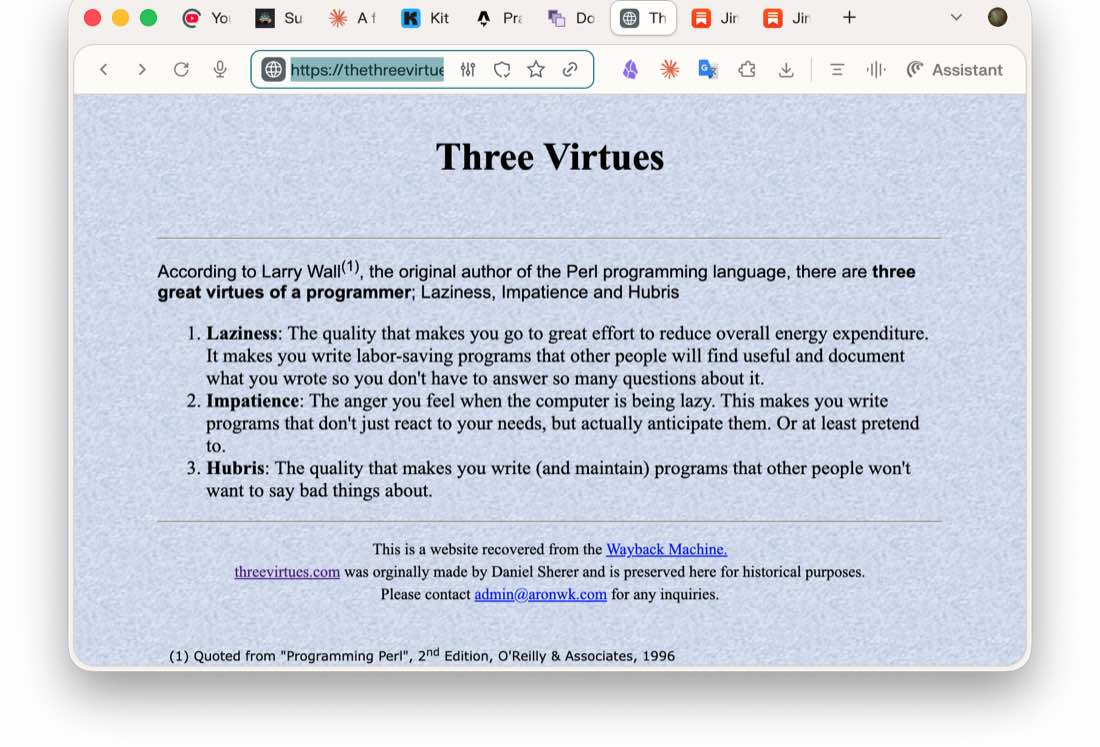
Take Laziness first:
“The quality that makes you go to great effort to reduce overall energy expenditure. It makes you write labor-saving programs that other people will find useful and document what you wrote so you don’t have to answer so many questions about it.”
Note “overall”. Wall’s lazy programmer goes to great effort up front, and writes the documentation, so that nobody has to come back to him later. My reading of that is that the ‘meat proxy’ saves their own time and spends everybody else’s, so the total goes up. That’s the wrong direction on the only number Wall is counting.
Impatience he defines as the anger you feel when the computer is being lazy — the thing that makes you build something that anticipates what you’ll need instead of waiting to be asked. Notice where it’s aimed. Wall is impatient with the machine. The meat proxy is impatient with the reading, which is the one part of the job that was theirs.
Hubris is caring enough that other people won’t want to say bad things about what you made. That’s not a feeling a pasted chatbot response earns.
The people who automate hardest also tend to check hardest. Drop the checking and you get slop.
I’ve been calling this hyperautomation, which is not a new term. Gartner, the technology research firm, coined it in 2019. Theirs is an enterprise idea about stacking several kinds of automation software together and running them as one system. Mine is simpler: the machine does what you told it, very fast, at a scale you couldn’t manage by hand.
Which is not automatically a good thing. People being able to do more, faster, is only good if the things they’re doing are worth doing. Forwarding unread chatbot output is a perfect example of doing more, faster, at something not worth doing.
Move fast and break things
And there’s a mindset this drops straight into. The “Move fast and break things” mantra came out of startup culture and hardened into hustle culture, and it was always a trade, which is what gets left out: you accept some breakage in return for speed, and somebody is meant to be watching what breaks. AI and automation hand that crowd a much bigger engine without adding any brakes. If you were already inclined to ship without checking, you can now ship a great deal more without checking, and the checks are the thing that didn’t scale. Access to this stuff has become the excuse — we can go faster now, so the gate that used to sit between “I made a thing” and “I sent a thing” quietly stops being worth the delay.
The naming matters because of what it does to your expectations. If you believe you’re talking to an intelligence, its output looks like an answer, and an answer is a thing you can pass along. If you know you’re driving automation, its output looks like a draft, and a draft is a thing you check.
Daniel Williams, who writes Claude Code for Non-Coders, took issue with a different word the same day. The story he’s responding to: OpenAI cut the price of one of its models by 80 percent after pointing that model at its own machinery and letting it rewrite parts of how it runs. (That’s his reported figure, and I haven’t checked it against OpenAI myself.) The headlines called it self-improving AI. His objection:
“That phrase is the thing this newsletter exists to argue with, because it quietly deletes every person who made the improvement possible.”
A person chose the goal. A person decided what “better” meant in numbers you could check. A person drew the boundary around what the machine was allowed to touch, and a person decided the result was good enough to ship. His phrase for it is “setting the aim and holding that last tap”.
The meat proxy has skipped that job entirely.
And then somebody has to press send
That gate is the whole job now, and it’s the one thing that hasn’t got any cheaper.
Every AI answer you’ve ever had arrived because a person decided what to ask. Every AI answer that was any use arrived because a person then decided it was worth passing on. That second decision is the one being quietly skipped — not because anyone made a case for skipping it, but because the machine got fast and the judging didn’t, and the judging is the part with your name on it.
Which is why the meat proxy isn’t being lazy in the way it looks. They’ve kept the automating and dropped the judging, and the judging was always the half that was theirs.
Try this next week
The next time you’re about to forward something an AI wrote to another human, stop and pick one of two options.
Put it in your own words. Read it, work out whether it’s actually true, and write two or three sentences of your own. This is almost always faster than it sounds, because most AI output is padded and the real content is short.
Or send the question instead. “I asked Claude about this and got something useful — worth asking it yourself, here’s the prompt I used.” That’s an honest hand-off. You are pointing them at the tool instead of relaying for it.
Either of those is fine. Pasting the raw output is the one that leaves the other person worse off than saying nothing would have.
And the limit, because there’s always one: sometimes forwarding the raw output is exactly right. If someone asked to see what the model actually said, or the output itself is what you’re discussing, then paste it. What goes wrong is pasting it instead of reading it.
— Jim
Hit reply and tell me the worst one you’ve been sent.