In plain English
Context is everything the assistant reads before it answers you, including its standing instructions. It has a limit, and every rule you add uses part of it. The four-eyes principle means nothing important gets signed off by one person alone; a second person checks it.
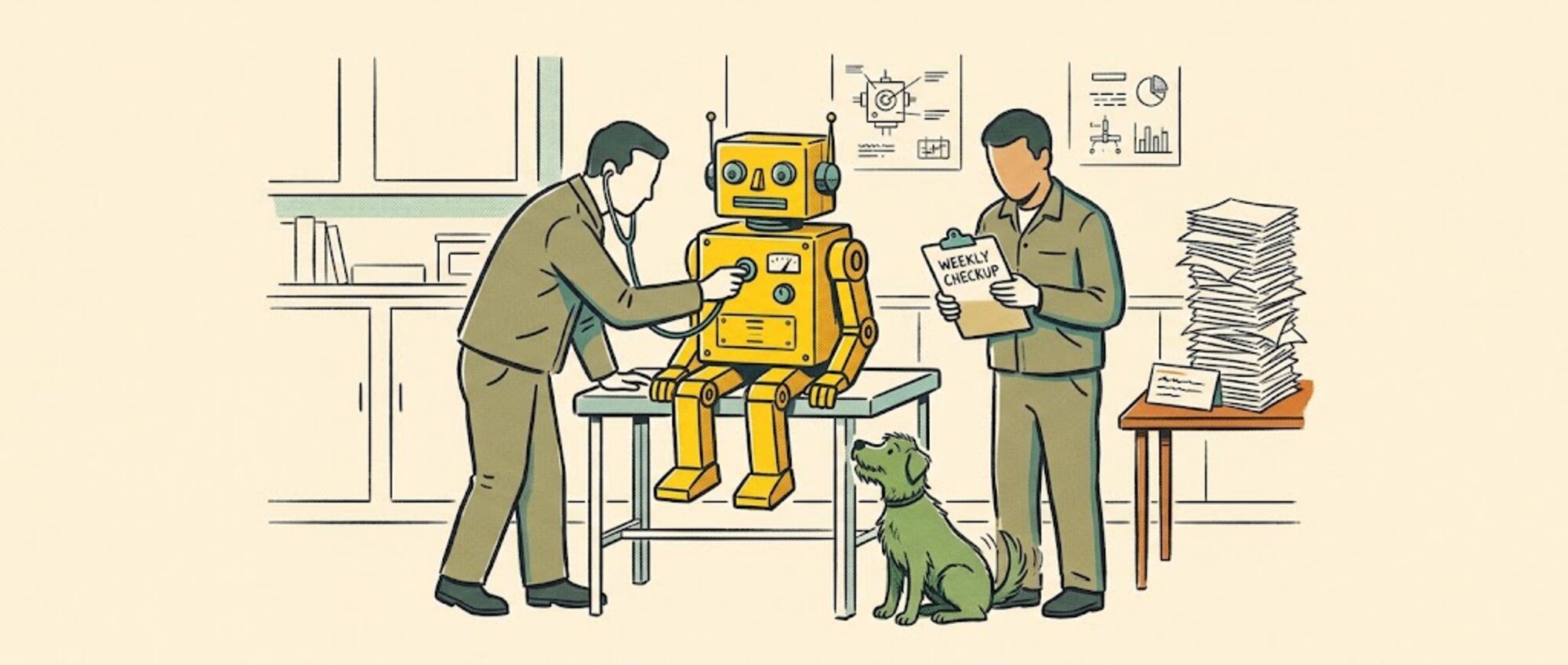
"Maybe once a week you just go through and do a bit of a bot checkup." That's what I told a team I'm training this week, about the assistant they all share. Ask it: were the instructions I gave you okay? Based on the chats we've had this week, "what improvements could be made to the instructions of the context to make this work better?" I called it good housekeeping — good AI hygiene.
What goes wrong is hard to pin down. It's a mix of things, and it changes from day to day, so I couldn't really put my finger on what an assistant that's drifted looks like. It just starts feeling less snappy, less accurate, less like it should be.
I used to do this on my own setup. In the early days I had a skill recommendation agent: look at the last few days of my daily logs and recommend an agent or a skill to help speed up the work I've been doing. In my experience Claude has got better at that over time, looking at what I've been doing and recommending skills to create. Lessons learned is the other one. That's more of a post-mortem when things went wrong, which can then go back and change the instructions on the agent or the skill, or even with the human.
It's the four-eyes principle: an extra look at your work from the outside in, to see what could be improved.
From a checkup, instructions get rewritten and rules get added. The trouble is that it can fill context up. You can end up with too many CLAUDE.md files — the instruction files Claude Code loads at the start of every session — filling context with a lot of rules at the beginning of every session. So whatever the checkup adds has to be succinct and terse. I wrote about deciding which rules are still doing a job in SoN 2.30.
Who runs it? Whoever created the bot, whoever runs it. Depending on the size of the team, I think there should be two people. Four eyes on it, and both of those people should be human: a quick bot check, make sure it makes sense, have a look at the instructions, and bring in another agent to check it if need be. I'm throwing the idea out there, but I think the higher-level agents should have someone with ownership and sponsorship of them, at least until people get more familiar, because they're getting built into how the business works.