In part 1 I listed the eight places school information reaches us, and the six questions I have to answer for each one.
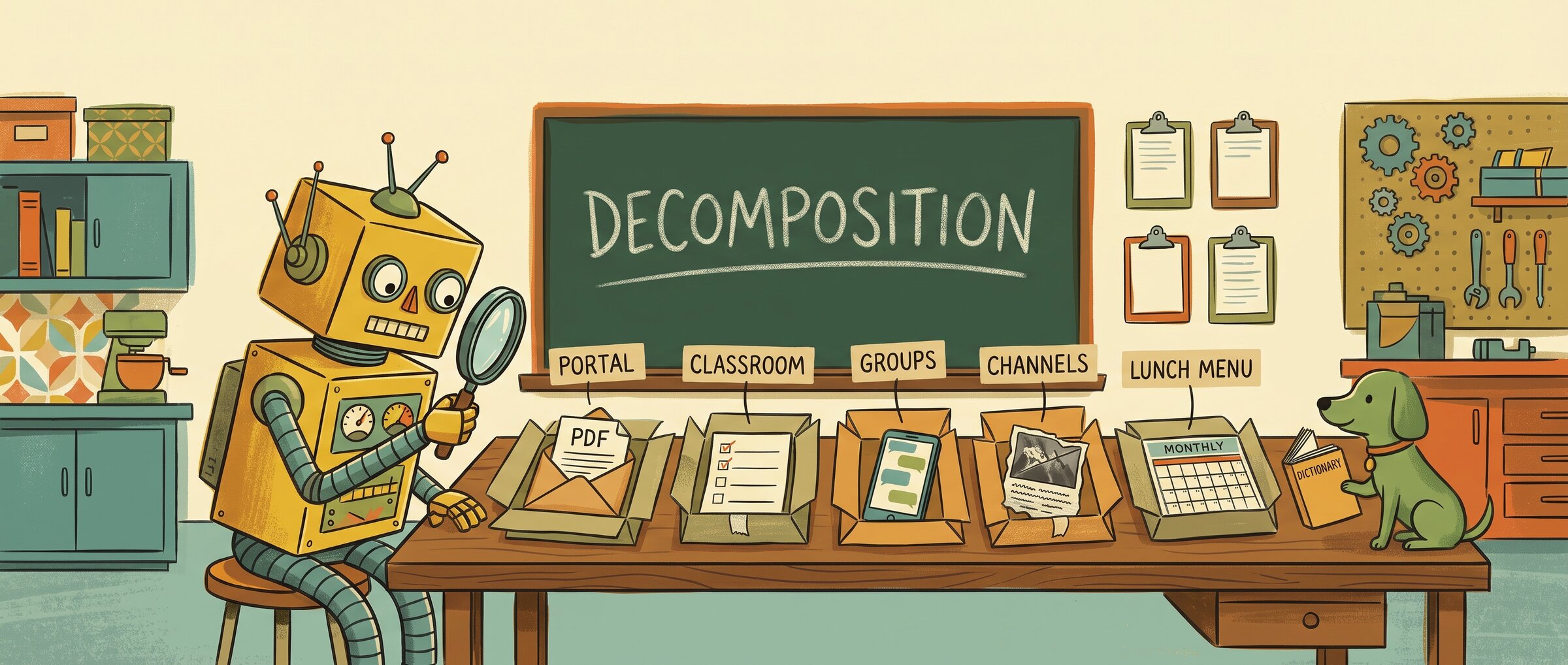
This is part two, and it's systems thinking, which I've discussed before in The Infinite Sandwich and the Made Bed. This is decomposition: the breaking things down part.
So it's time to look at all the outputs coming my way. For each one: what information is available, what format it is in, and the blockers and pain points that come with it. Then what the ideal solution looks like.
The school information portal
You get a notification or an email saying there's something waiting for you. You open the announcement and the text says the announcement is attached as a PDF.
So you download the PDF to your phone, somewhere you can't open it natively. You confirm that you've downloaded it. Then you go and find where it was downloaded and open it. And if you're a foreigner like me, you then need a way to translate it to make sure you've understood it.
That's a lot of blockers. The school could have just put the information in the text.
The portal also holds grades, events happening at the school, ways to register absences, general reporting, the weekly timetable with homework and exams flagged, and circulars like the monthly lunch menu.
Google Classroom
Google Classroom had a list of missing work. When I went through the list, it was mostly paperwork and an in-class exam.
That tells me some teachers use Google Classroom to assign work but don't give it a due date. Others do give it a due date, but the work is never uploaded to Google Classroom. So the due date flies by and it looks like something has been missed, but it hasn't actually been missed. It could never have been uploaded anyway.
Five or six teachers use it, and they don't all use it the same way, but Google Classroom doesn't give the person reading it the same flexibility. You still have to go through each class, the to-do lists, all the different areas and the class comments to find out where things stand.
The WhatsApp groups
They're useful, but they're also a lot of noise. The class parents at one school use them to keep in touch. There's also a WhatsApp group for a class from two years ago, and the parents still keep in touch there, with information about parties and things.
The Telegram channels
Then there are Telegram groups for the parents of those old classes as well. And there are Telegram channels from the local councils, so I have to keep up with both, because their information can differ depending on the weather.
Things come through as a mix of images and text. My agent or I can read the text, by copy, paste and translate. The images can't be read that way.
The lunch-menu website
The catering company handles lunches for all the schools in the area. The kids' menus are released monthly. Our kids are vegetarian, so we need the kids to know what they're eating during the day. It also lets us make sure we don't make the same meal again when we get back home.
The language
The messages mostly come in both Castellano and Valenciano, and they need to be analysed further. It's difficult for me, but that's a me problem.
The ideal solution
The ideal solution is a queryable, accurate system that we can use, rather than having to go to all these different places of information separately.
The next question is how we figure out all the directions the information comes from. What does that flow chart look like, and where do we pull it into?
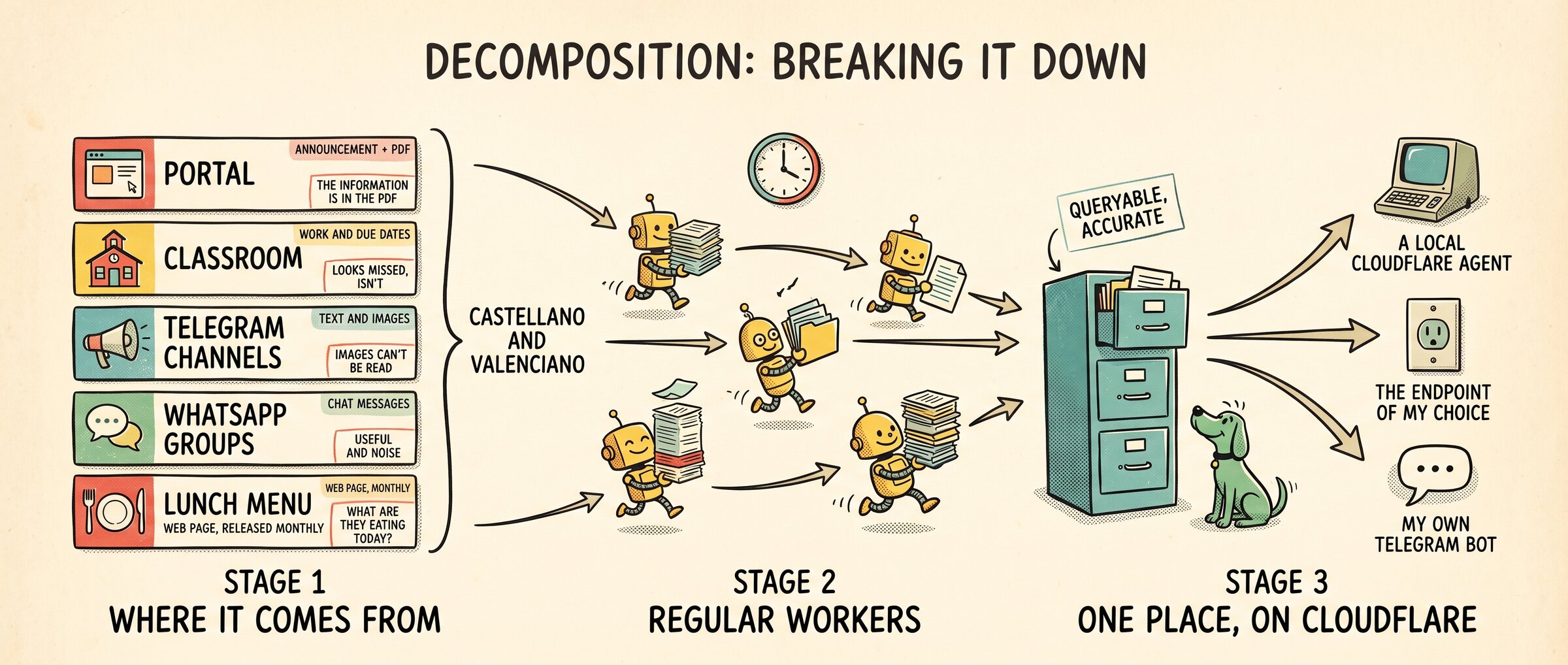
My end result is to put it all on Cloudflare. I want workers regularly looking at each source and uploading what they find, so I can go to one place and query it, through the endpoint of my choice, or even through my own Telegram bot.
Parts one and two identify the problem and where all the information is coming from. In part three, I'll start to disassemble and untangle it, so it can be routed better for us.