
If you have spent even five minutes reading prompt advice online, you have seen the recipe:
"Act as an award-winning CMO with 20 years of experience..."
"You are a world-class marketing strategist..."
It is comfortably the most copied piece of prompt engineering advice on the web. It is also the digital equivalent of this photograph I took on a cobbled street in Rome back in 2014:

A tiny electric city runabout badged with a BMW roundel, bearing a label above the windscreen that proudly reads "BATMOBILE".
It is charming, it makes you smile, but nobody in their right mind expects that machine to outrun the Joker through the streets of Gotham. Taping a label across the windscreen doesn't change the chassis, the horsepower, or the turning circle.
Yet when people sit down in front of a Large Language Model, that is precisely what they do. We type "You are a senior brand director," sit back, and expect the model to conjure executive judgement, taste, and decades of commercial scars out of thin air.
When it predictably hands back generic corporate oatmeal packed with phrases like "in today’s fast-paced digital landscape," people end up frustrated.
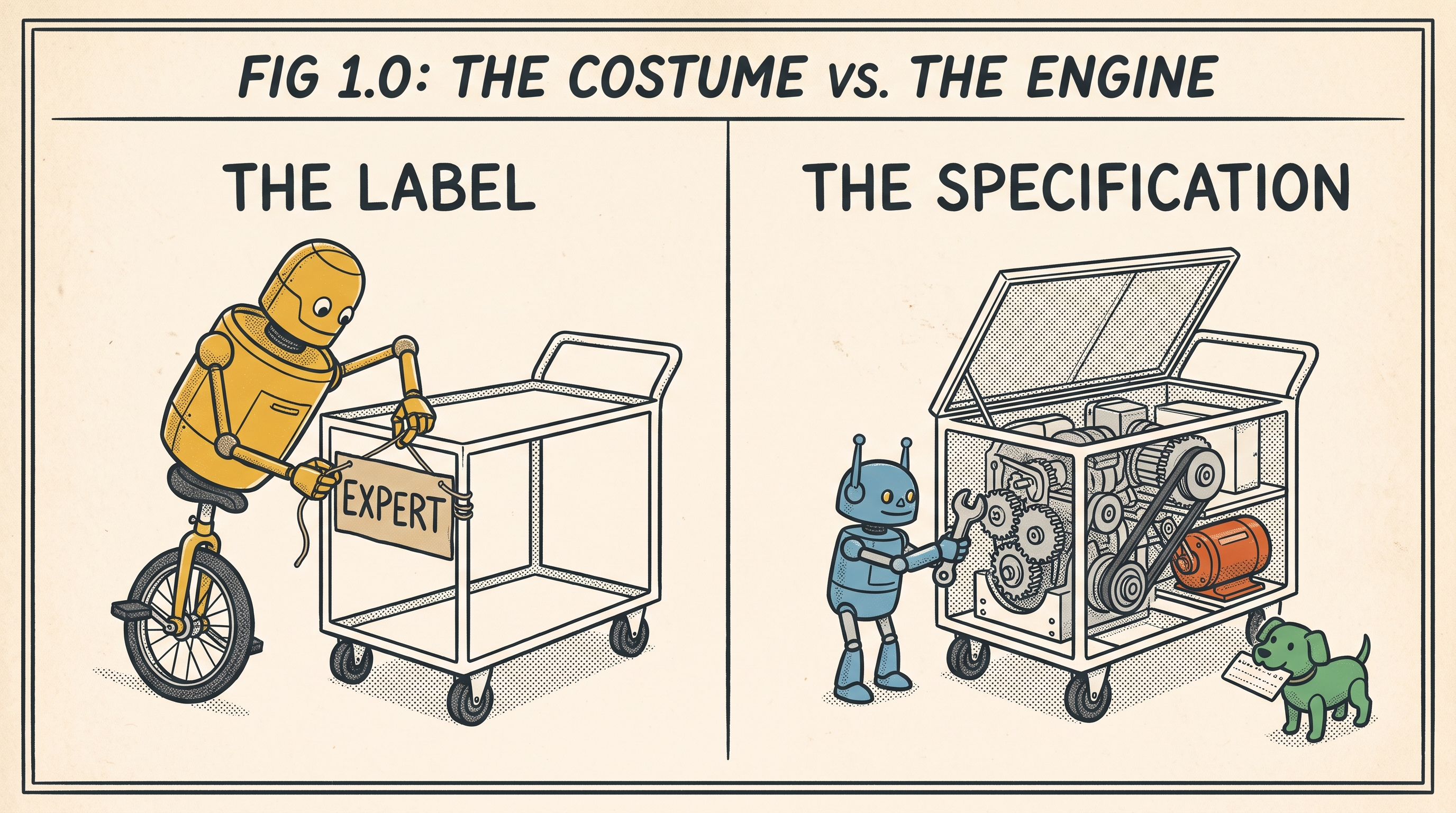
Role lines give users the illusion that the work is already done. But an agent doesn't need an identity; it needs a specification.
What the Role Trick Does (and Doesn't) Do
Language models aren’t minds; they are statistical pattern engines. They predict the next token based on the weights and distributions of everything they have absorbed.
When you tell an LLM "You are a marketing director," you aren't activating a latent degree in consumer psychology. You are simply nudging the needle into a specific corner of its latent space. You are telling the machine to steer toward the vocabulary, cadence, and corporate jargon commonly found in public agency pitch decks and LinkedIn thought pieces.
- What it does: It sets a tonal dialect. It tells the machine to speak in marketing adjectives rather than clinical lab notes or Python syntax.
- What it doesn't do: It doesn't grant judgement. It doesn't tell the model what a persuasive argument looks like for your specific product, what commercial constraints matter to your buyer, or what to avoid when the prose starts drifting into fluff.
A title gives you the costume, not the actor’s craft.
Why Last Week’s Cartoon Gem Works
Last week when I was building a custom Gem to write single-panel editorial cartoons, I didn’t just write: "You are the greatest cartoonist who ever lived, go make funny gags."
If you do that, you get stale dad jokes and punny wordplay that would embarrass a Christmas cracker.
The cartoon Gem succeeds because it is governed by an explicit style guide and rules engine:
- Negative Constraints: Strictly no talking animals, no generic office watercooler clichés, and no captions that merely describe what is drawn.
- Mechanical Framing: A strict comedic formula based on juxtaposition—the visual establishes a familiar mundane premise, while the single-line caption subverts it entirely.
- Exemplars: Side-by-side examples of sharp gags alongside rejected bad gags so the system understands where the line between witty and lazy sits.
The agent works not because it believes it has a Pulitzer Prize pinned to its chest, but because it has the exact boundaries and success criteria required to construct a valid result.
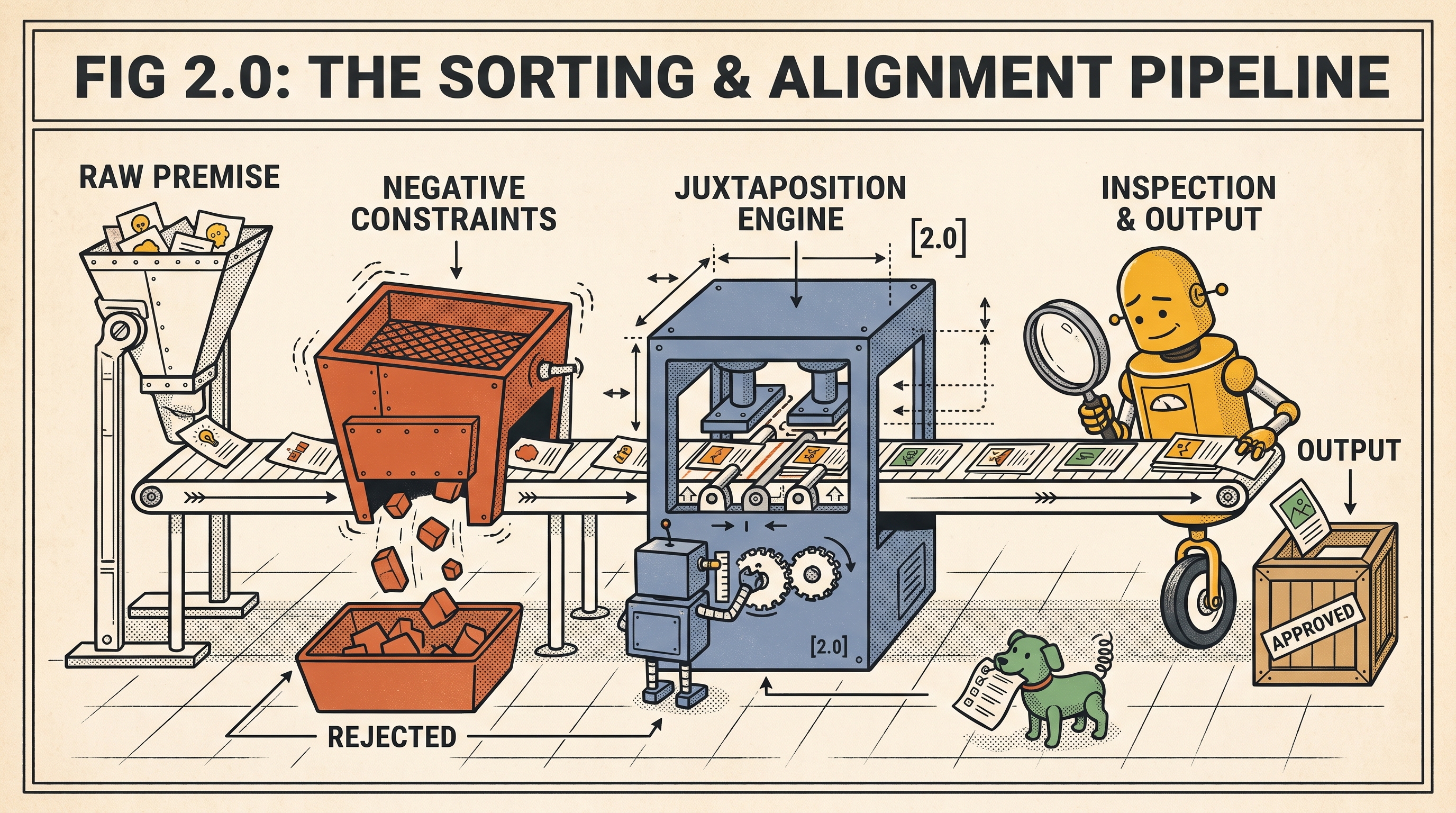
Figure 2: Inside the Gag Studio: raw comedic premises pass through negative constraints and an explicit evaluation rubric before final output.
What to Feed an Agent Instead of a Title
If you want an agent to produce work of real caliber, you have to stop playing dressing-up and do the groundwork yourself. You need to supply the three things that actually govern expert output:
1. The Raw Material, Not Just the Goal
Human experts rarely produce brilliant strategy out of thin air; they ask for the customer interview transcripts, the conversion data, and the messy user feedback. If you don't supply the raw source material, the model will invent plausible-sounding generalities to bridge the gap. Feed it the facts, the quotes, and the specific inputs first.
2. The Standards It Is Judged By
As KnowBot demonstrated when he froze in front of an already-made bed, automated systems must understand what "done" actually looks like. Give the agent an explicit rubric:
- "Lead with the concrete problem in the opening sentence without rhetorical questions."
- "Reject corporate buzzwords like 'game-changer', 'delve', or 'unleash'."
- "Keep sentences punchy and grounded in physical analogies."
3. Concrete Few-Shot Examples
One pristine example of an approved brief is worth a thousand descriptive adjectives. Show the system what good looks like:
- "Here is an excerpt from last quarter's winning brief."
- "Notice how each proposition is backed by a specific customer constraint rather than broad claims."
No matter how capable modern LLMs become, machines are not wizards. Slapping a label on the windscreen is an easy shortcut, but it won't get you out of the driveway.
If you want high-performance output, peel off the Batmobile sticker and build the engine.