
Ooh, Shiny New Tech Acronym…
Don’t have time to read this week’s issue? Why not copy/paste it into your AI agent and ask it for insights?
You might have seen this acronym doing the rounds: AEO. Answer Engine Optimisation — or GEO, Generative Engine Optimisation, if you prefer. The pitch is everywhere right now: “Search is dying!”; “ChatGPT and Perplexity are eating Google!”; “Your competitors are being quoted by the robots while you sleep!” — so buy the framework, before the window shuts.
I’ve been building websites, and dealing with the agencies who sell this stuff, for years, and to be frank: the entire commercial aspect of SEO has always struck me as being dangerously close to selling snake oil. Not because it’s fake, but because of how it’s sold. You get told you have to pay someone to do the thing you ought to be doing anyway.
So I’ve been looking for the details, and here they are, sans urgency: Write with authority and know your subject. Structure it so a person can follow it. Be specific, keep it current, add clean schema. That’s the secret.
In other words: good, relevant, timely content, backed by rich, up-to-date schema. Which is exactly what you’d do if you just wanted to be useful. The playbooks more or less admit it — somewhere near the back they’ll tell you the fundamentals never change. A hundred pages selling a revolution, and a line at the end conceding it’s the fundamentals, rebranded.
You don’t have to take my word for it. In May, Google published its own guidance on showing up in AI search, and spent a whole section on the “GEO hacks” you can ignore: the special AI files, the chunking, the rewriting for robots, the magic schema. Its own John Mueller said it plainly — to show up in AI answers, do normal SEO. There’s no separate engine to game. The AI sits on the same ranking that was always there.
However, if I’m being fair, there’s one genuinely new thing in here, that I don’t think is a con. It’s a little file called llms.txt — a plain map at the root of your site that tells the AI which pages matter. Does it work? Well, nobody knows yet. Web crawlers barely fetch it, and Google can’t even agree with itself: one part says ignore it, another quietly checks for it.
But that’s how the web has always done it. We had RSS, XML, a dozen ways to carry a feed before one stuck (VHS and Betamax for those of you with chronic back pain). You push a thing until it’s adopted, or it isn’t. So my take is that ultimately, llms.txt costs you nothing, an AI will write yours in a minute, and Google isn’t the only player anymore. Do it to hedge your bets — not because anyone can sell you a result from it yet. Same with schema, same with Wikidata: do them because they’re good practice, full stop.
Before you hand anyone money for an “AEO or GEO package,” ask the one question that matters: What are you doing right now that isn’t working? Go and look at your numbers (and don’t count ‘clicks’. Clicks are vanity). Is the traffic converting? Are you even getting the right people on your site?
Because that’s not AEO. It’s just good digital marketing, same as it ever was — and the fundamentals never changed. People want the shiny new thing because it’s got a new name on it and AI’s the thing right now.
So: look for help where you genuinely need it. A content strategy, someone who actually knows marketing — that’s money well spent. Just don’t let yourself get suckered in by YATA (Yet Another Tech Acronym) ;-)
P.S. — Remember the network orrery I was going to make with Claudef Fable from this week’s earlier post? The first pass has just finished: my whole home network, rendered as a kind of solar system. Here’s what it looks like so far…
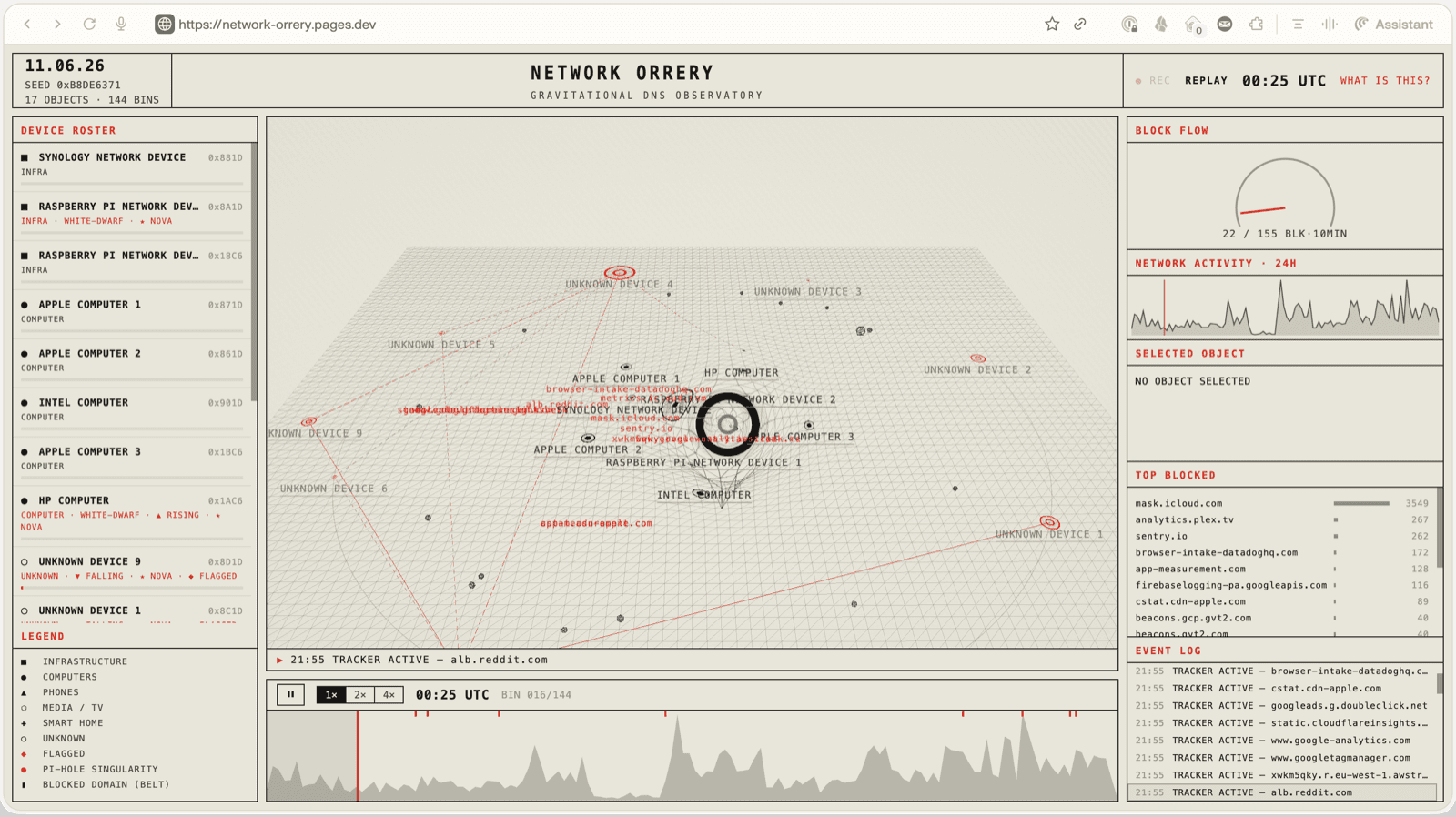
Have a poke at the live version: network-orrery.pages.dev. Full write-up next week.
Second Brain Chronicles
What I’ve been doing with AI this week.
AI as your paralegal
This week I needed a proper mutual NDA — the kind you sign with a client before a discovery session, covering confidentiality, consent to record the meeting, and what happens to the recording afterwards. The usual options are a generic template off the internet, probably written for US law, or a few hundred euros to a solicitor for boilerplate I’d only end up reusing anyway.
So I had AI do the legwork. I asked it to research the law that actually governs this in Spain — and to show me its sources, so I could check them myself. It came back grounded in real statutes: the Spanish trade-secrets act (Ley 1/2019), the GDPR consent basis (Article 6(1)(a)), the data-handling rules under the LOPDGDD. Then I had it draft the whole thing as a fill-in template — every client-specific detail left as a marker, with my standing policy baked in: recordings are internal-analysis-only, deleted within 30 days of the report, never shared, never used to train AI. A one-off job, turned into something I reuse.
Here’s the important bit, though. I could only do this because I’m familiar enough with NDAs to know where the gaps are. That’s the rule: if you know where the gaps are, use AI to fill them — not to write something you can’t check. Then we run it past the four-eyes principle: someone else reads it before it goes anywhere. We sent ours to the client first, too, to make sure they were happy with it. And if you’re not certain, get a human professional to look at it.
Tool of the week: Resend
A quick one for the back pocket. Resend is an email service built for sending mail straight from your code. I started on the free tier and ended up paying for it.
It doesn’t sound amazing when I say it out loud, but here’s what it does for me: my system emails go out through it — the login links for my members’ areas, an invoice notice, a payment confirmation — all from my own domains. The bit I like is I can tell an agent at the command line, “send so-and-so the reminder,” and it drafts it and sends it.
One honest catch: Resend only sends. It isn’t a mailbox — there’s no inbox to read, so for receiving you still need something else (I use Cloudflare for that). It’s a developer’s tool, really — you, or your AI, wire it up once. And it won’t replace your newsletter; that’s a different job.
But if you ever need a script or an agent to send a real email — a receipt, a reminder, a login link — it’s a good little utility to have in your back pocket.
Until next week
- Jim