
Stay In Your Lane (Then Go Deeper)
Don’t have time to read this week’s issue? Why not copy/paste it into your AI agent and ask it for insights?
Honestly, I’ve been so busy I forgot what day it was and started the newsletter too late this week. But as I think I’ve mentioned before, with all the computer and AI use I’m stuck in every day, I need to give myself more permission to be human when it counts. If that means I’m too shattered on a Monday night to start writing, then so be it. Perhaps that’s an authenticity heads-up that I’m not divvying out the writing and ideation to my agents.
The last two weeks have been pretty rife with car trouble — namely my T5 VW Caravelle, which I imported from the UK when we moved to Spain four years ago. On top of it not passing its road test this year, on the way back from the garage (and thankfully within metres of my front door), something blew — literally — out from underneath the car, making it suddenly feel as if I was driving on four flat tyres. I managed to get it parked, then started assessing the damage. The tyres were all intact, but there was fluid leaking from the bottom of the driver’s side, steaming out every time I turned the wheel or tried to manoeuvre it.
From snapping pictures and loading them into Perplexity, to describing the symptoms to Claude alongside PDF copies of my import and road-test paperwork, I was able to construct a full picture of what happened — and came to the conclusion that whatever hose, pump, or array feeds the driving assist (the power steering, I guess) had completely blown.
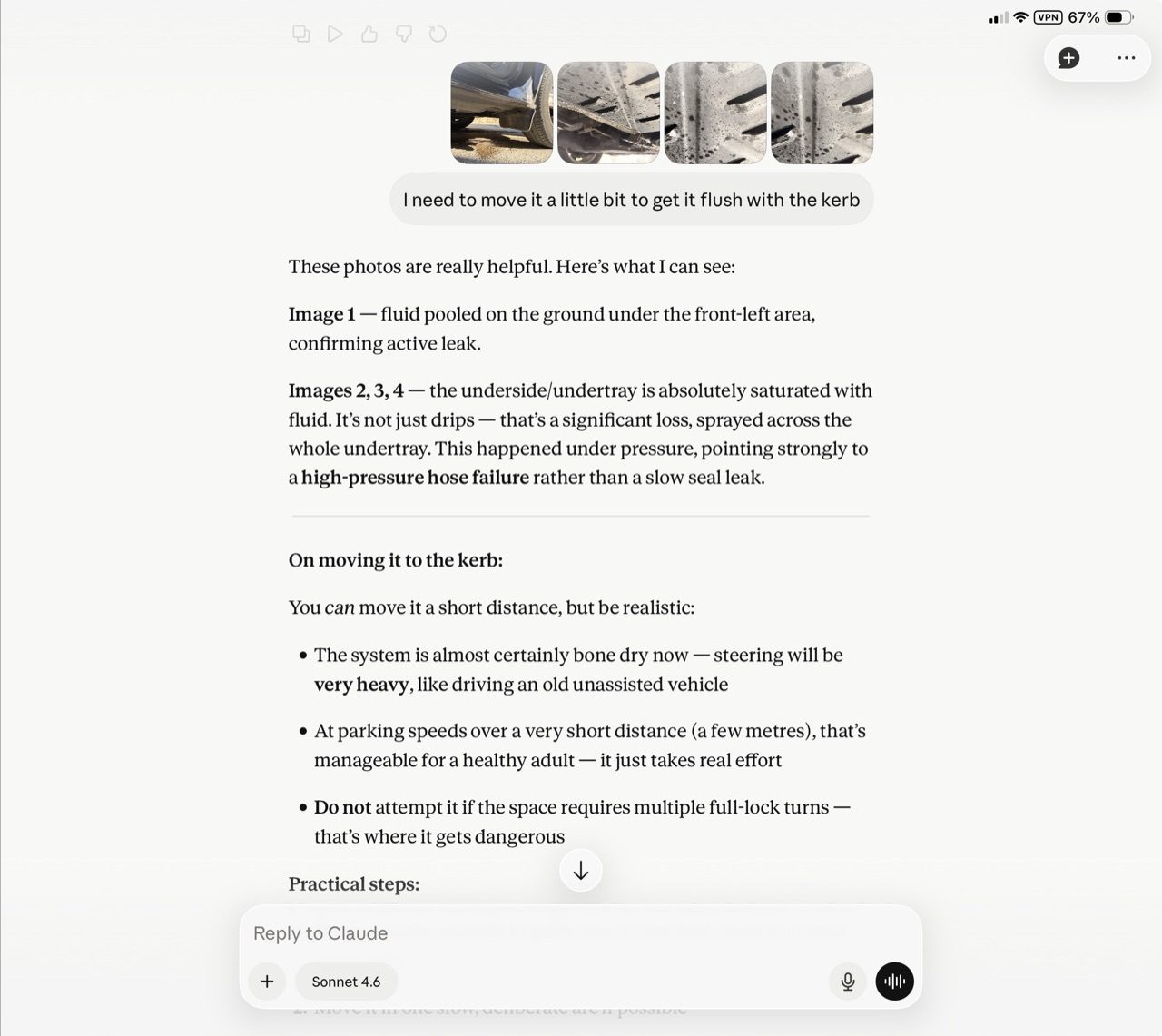
Claude, on the photos from under the van: “the undertray is absolutely saturated… pointing strongly to a high-pressure hose failure.”
Reader, I’ll tell you that AI-assisted search and reasoning can only get you so far these days, especially when you’re not an expert — and it’s good to bear that in mind. I was a breath away from ordering the part I was convinced was broken, hoping to save the mechanics time searching for it and potentially shipping it from the UK at a high import cost. But then I realised — hey, it hasn’t even been properly diagnosed yet. Yes, it’s highly likely, based on the anecdotal and photographic evidence, that the pump and hose array for the steering assist blew. But there was no expertise yet to confirm it. And that is where I stopped.
Now, you might say to yourself: yes, that makes sense. But in the moment, I was letting my AI (Claude) keep prompting me to further action. Yeah — you can read that back. Who’s getting prompt engineered now?
Claude, ChatGPT, Gemini — even Perplexity, I’ve found recently — just want you to keep going. They want to be used, to be useful — and they’re not wrong to want that. And I’m not talking about hallucinations or bias here. In this week’s experience I was running three research tools on top of Claude — it was finding real places in the UK and Europe, pulling real prices, and verifying that the pump/hose array has a different VW part number for RHD (UK) cars than it does for LHD (the rest of Europe). Great. Solid information, as far as I can tell. And “as far as I can tell” is exactly where I was meant to stop. This information belongs in the hands of my mechanic — assuming I’ve even diagnosed it properly.
Check this yourself next time you use your AI. Is it quietly encouraging you to continue? Or does it know when to say enough is enough?
The part that I’m working on over and over in my head is the authenticity risk — for want of a better way to put it. I’m highly confident that the results I was getting back from my AI were accurate. But the danger was that I had no way of verifying that as I’m not a mechanic. I can’t look at a steering pump and tell a confident guess from a confirmed diagnosis. So when three tools all nodded along and started lining up part numbers, I had nothing to push back with except a nagging sense that I was getting ahead of myself.
That’s the whole game, really. AI is brilliant inside the patch of ground you actually know — the place where you’d catch the moment it started talking nonsense, because you’d recognise nonsense when you saw it. Step outside that patch and it’ll still answer you, just as confidently, and you’ve no way to mark its work. The move isn’t to stop using it. It’s to know where your lane ends, and to hand the rest to the person who owns that lane. In my case, a workshop with a ramp and domain experts.
So the better question isn’t “what can AI do for me?” It’s “how do I use it to go deeper in my own domain, instead of bluffing my way into someone else’s?” What data is out there that could actually help you level up where you already know your stuff?
That brings me to this week’s paid subscriber tool — an open-data lookup agent for your own area of expertise. I built it deliberately as the opposite of the thing that nearly had me ordering a steering pump.
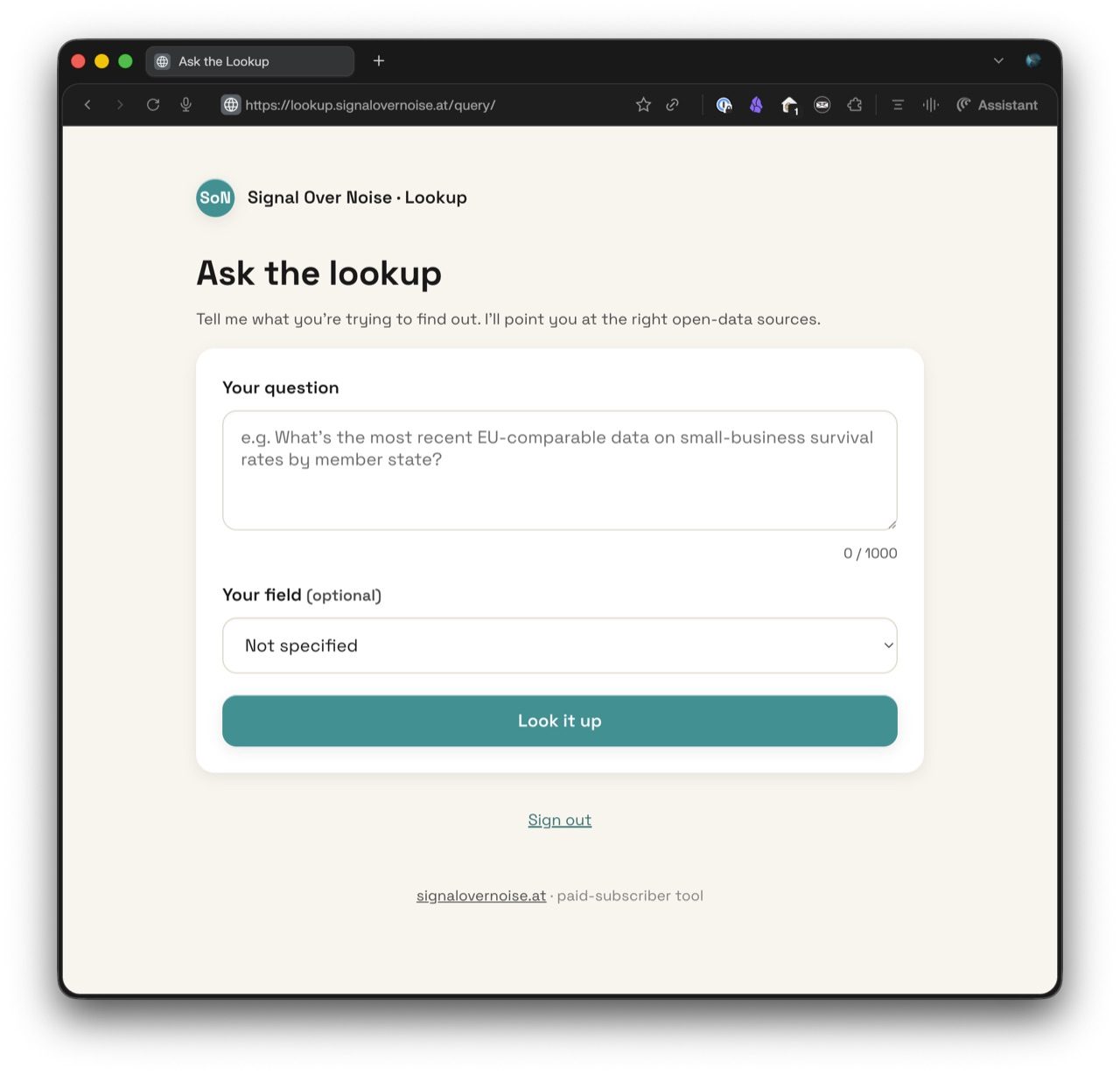
Login using the same email address you used to sign up for Signal Over Noise and you’ll get a magic link sent to you.
It’s a librarian, not an oracle. It won’t answer your question for you, and it won’t push you to act on anything. What it does do is point you at the trustworthy open data already out there — published by governments, statistics offices, and national open-data portals — tell you honestly where each source is weak, and show you how to actually use it once you’re there. There’s so much of it that most people don’t know where to start. You can start here. Put in a bit of background about your domain and the question you’re chasing, and it’ll route you to the specialists worth reading — then get out of your way.
As this email lands in your inbox, a tow truck is hooking up the T5 to haul it to a garage in the next town over for a proper diagnosis. I still reckon it’s the power steering. But I’ll let the experts in the garage be the ones to tell me that.
Until next time Jim
— Jim