


TL;DR
Most of the time a task eats is execution, not thinking, and that is the part agents can take. Planning, researching and deciding still need your attention. Iterating, installing, configuring and checking do not need it in one unbroken block, which is what makes the work survive a week with the kids at home.
Two subscriptions came out of my stack this week by looking for existing open-source software rather than generating new code to replace them — MoneyWiz to Actual Budget, and Semrush and Ahrefs to a self-hosted OpenSEO. Sourced code arrives with a history you can inspect. Generated code arrives with no reviewer but you.
In plain English
Vibe coding is asking an AI to write software for you. Vibe sourcing is asking it to go and find software that already exists and does the job, then help you set it up. The difference matters because generated code has never been read by anyone, while an established open-source project has commits, a maintainer, an issue tracker, a licence, and a public record of any security flaws found in it.
Self-hosting means running software on a computer or server you control instead of paying a company to run it for you. It is usually cheaper and sometimes free, and the trade is that you are the one responsible for keeping it working.
An MCP server is a small adapter that lets an AI assistant use a tool directly — so instead of opening a dashboard yourself, you ask the assistant and it queries the tool for you.
There’s a perceptible shift about “being busy” and “being productive” and thinking that it has to happen within a designated few hours. While I recognise that as productive humans, we need focus time, time uninterrupted to sort and assign our own thoughts, the advances of technology are making it easier for us to not necessarily have the need for such an amount of time blocked for the “doing”. Which is fine in a way, as someone once said “we are human beings, not human doings”.
I’m still using paper and pen to write things down (shocker!), and when I need to, I reach for my phone to text with my agent sitting back at my home computer. I am literally assigning it tasks, then taking a sip of coffee or letting the kids deal a new hand of Go Fish after making them lunch. This new future of how work is getting executed — issuing commands to my agent then going to the next focus — is just how my week works now.
I want to make a point of the execution vs anything else. If planning, researching, strategising take up, say, 40% of a task, then 60% is left to execute, iterate etc. That 60% can take up 100% of your available time if you’re doing it manually. But handing off to agents cuts that down considerably.
Things I’ve done this week
Here’s some examples of the 60% in action:
Setapp is a Mac subscription I’ve been using since February 2017. It’s been one of the few SaaS products that has offered very good value for money, more often than not. For about 20 USD a month, you get access to a curated set of apps for Mac (and some free companion iOS versions) that’s constantly growing and is now somewhere in the hundreds. I probably use 12 of them and have been wondering if the cost of the subscription is still worth it for me. One app that I rely on heavily is MoneyWiz, which links to my banks and helps reconcile everything and set budgets. If I were to get rid of Setapp, I would have to either pay a separate license for the MoneyWiz software, or find an alternative.
This is where I think there’s a growing counterpart to “vibe coding”, and that is what I’m calling “vibe sourcing”. I’ve spoken previously about how the rise of agentic programming and general access to the layperson is ushering in a new age of software development — but there is still a horde of software treasure out there, open-source, ready to install, tweak and contribute to.
Vibe coding gives you code nobody has read, because it didn’t exist until you asked for it. Vibe sourcing gives you code with a history — commits, issues, a licence, a maintainer, and any vulnerabilities somebody already found and filed. On generated code, you are the only reviewer it will ever get. On sourced code you can look at the last commit date, how the maintainer answers issues, what the licence actually permits, and whether there’s a CVE against it.
In practice it starts the same way as vibe coding, with “I need something that does x”. You just don’t finish the sentence with “so build it”. You finish it with “so help me define the requirements, then go and find the open-source projects that already meet them”.
That has been the majority of upgrades that I’ve been doing to my systems lately, and on Thursday night I sat down with my agent to reason out alternatives to my 12 most used Setapp apps, including MoneyWiz. Now, about four hours later, I have a new list. Three of the apps I could have been using command line utilities for. Five more of them have open-source alternatives. Two alternatives are completely free, and the MoneyWiz replacement — Actual Budget — just finished installing on my cloud server. That same server runs about five other cloud services for me and costs about 7 EUR a month.
The same thing happened earlier in the week with SEO tooling. I’d been looking at Semrush and Ahrefs, which are the two names everybody reaches for and which cost real money every month. Instead I found OpenSEO, an open-source alternative, and spent an evening putting it up on Cloudflare behind a login that only lets me in. It does site audits and rank tracking on a schedule, and I wired its MCP server into my agent so I can just ask it things. The hosted version of the same software is 10 USD a month. Self-hosted, on infrastructure I was already paying for, it’s free. That’s two subscriptions reasoned out of my life in one week.
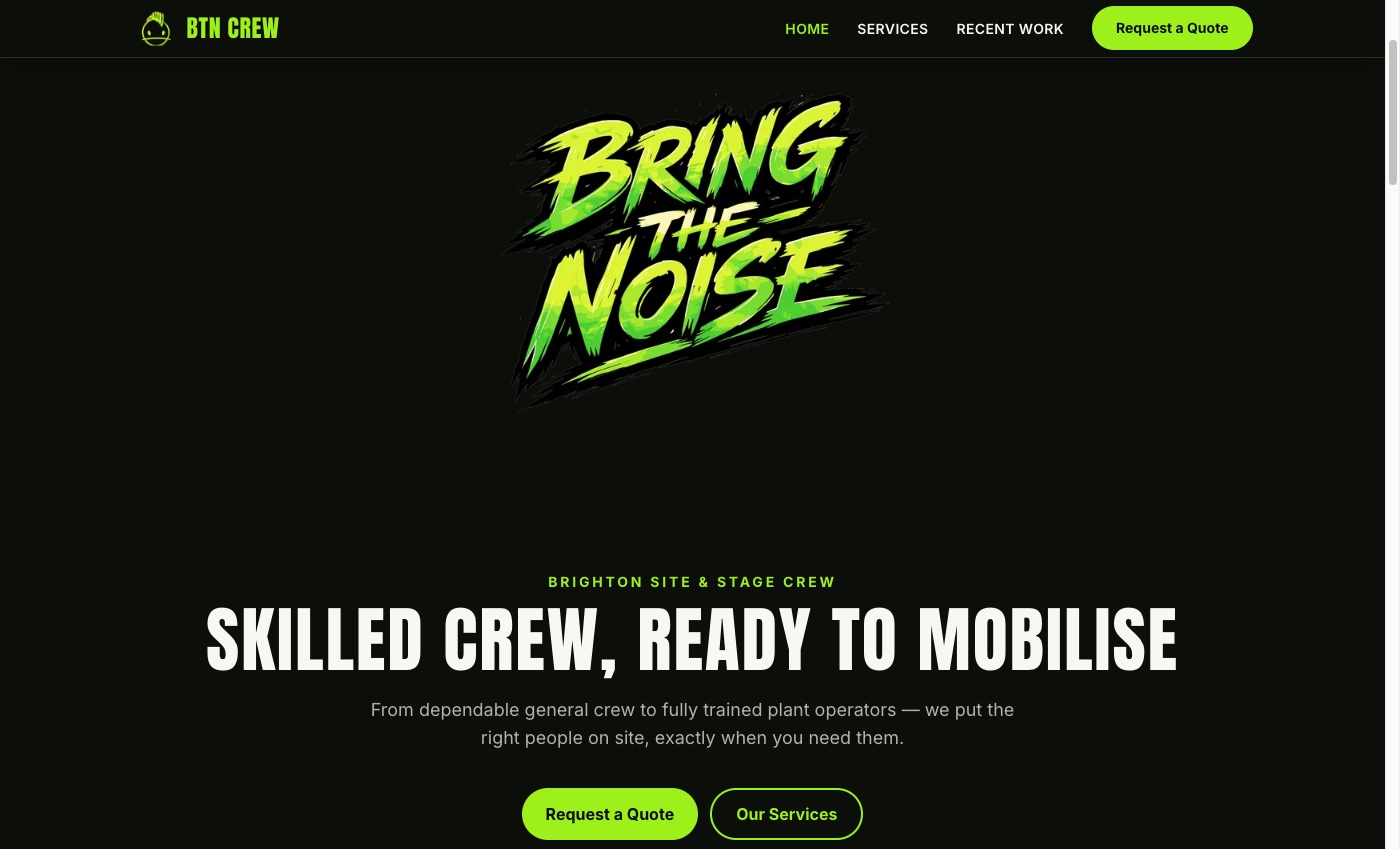
Elsewhere it’s been a heavy week of shipping and testing new ideas. BTN Crew, a Brighton-based site and stage crew company, was relaunched for a client after being liberated from Wix.
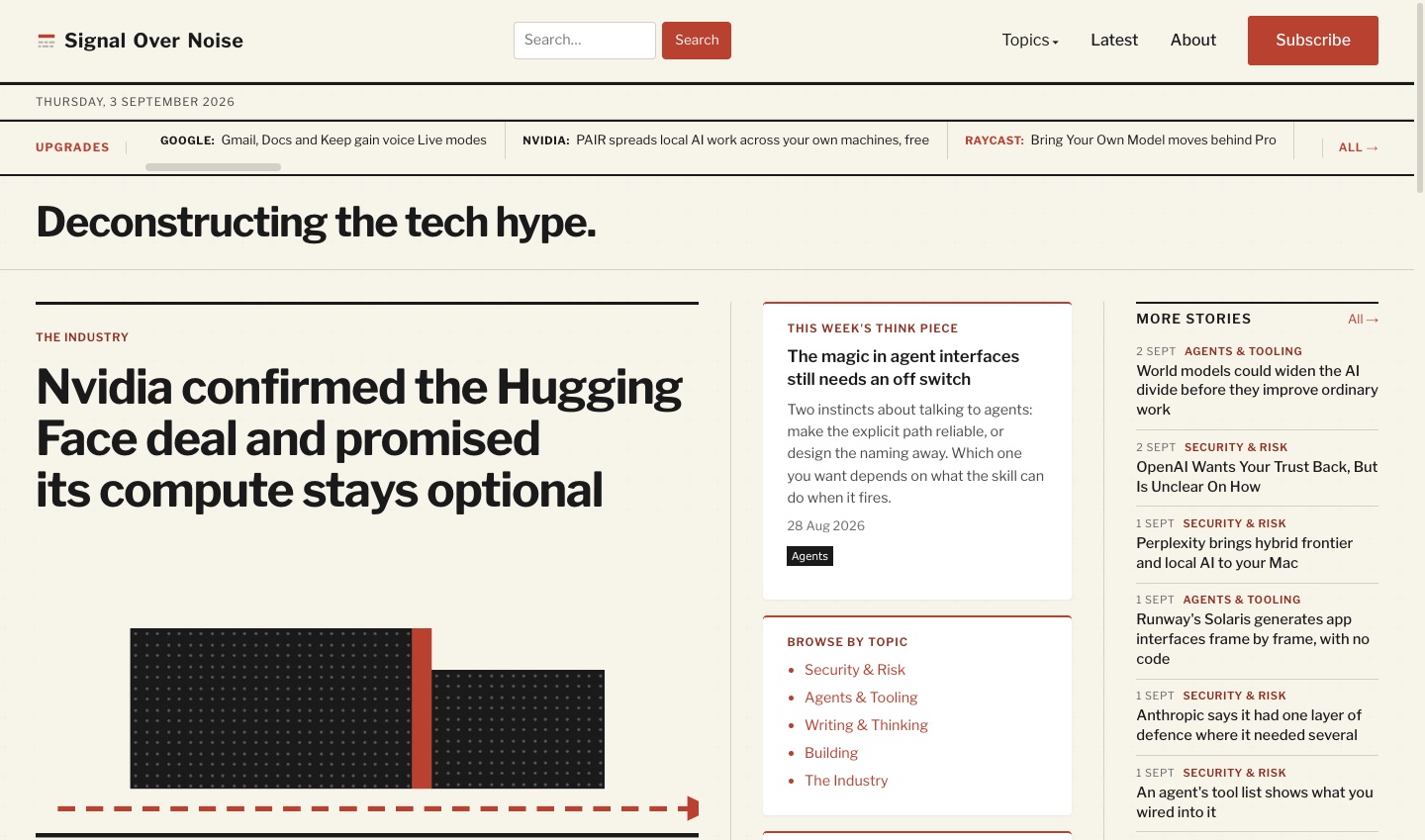
Signal Over Noise itself got a lot of quiet plumbing — a glossary that now auto-links itself across every post and the new Upgrades wire on the homepage.
Almost none of that needed a long uninterrupted block. It needed me to decide what I wanted, and then to check the work that came back.
Other things I’ve been looking at this week
World models are something that’s been slowly creeping into my feeds, described as the next evolutionary step onwards from text-based models, or LLMs, which is what you and I are used to using. They’re the basis of all of our chat-based agents. A world model is software that holds some representation of an environment and predicts how it changes, particularly in response to an action. A language model predicts the next piece of text. A world model is meant to predict what an environment will look like after something happens in it.
It’s something that’s still hard to wrap my head around. Have a look at this:
That’s Runway’s Solaris, out at the end of August. They’re calling it an interface world model — it generates the interface frame by frame as you use it, in real time, with no code underneath it at all. It isn’t a design tool that spits out a React app at the end — there’s no app underneath for it to spit out. It draws the next frame of the interface each time you click, and that’s the whole thing.
I wrote about it properly on the site this week, along with a piece on why world models could end up widening the AI divide rather than closing it, given how much compute they need to run:
I don’t know yet whether this is the next step or a very good demo, but it’s fascinating watching it happen.