

TL;DR
- After more than 25 years primarily using Macs, I moved my daily work to a Lenovo ThinkPad running Omarchy.
- Omarchy gives me fewer distractions, more useful ports and more freedom to customise the computer and connect it to my agent system.
- The move is incomplete: I still rely on my Mac mini for some native apps and accumulated automations, but openness and local control matter more to me now.
In plain English
Omarchy is an opinionated Linux desktop built on Arch Linux and Hyprland. It supplies a complete set of defaults while leaving its configuration, scripts and source open to change.
System Integrity Protection is a macOS security feature that restricts changes to protected parts of the operating system, including changes made by software running with administrator privileges.
Sandboxing limits which files, services and parts of a computer an application can access.
Last weekend I installed Omarchy alongside macOS on my M2 MacBook Air. Support was hit or miss on the Mac, but I was hooked. I realised this was an operating system I wanted to live with.
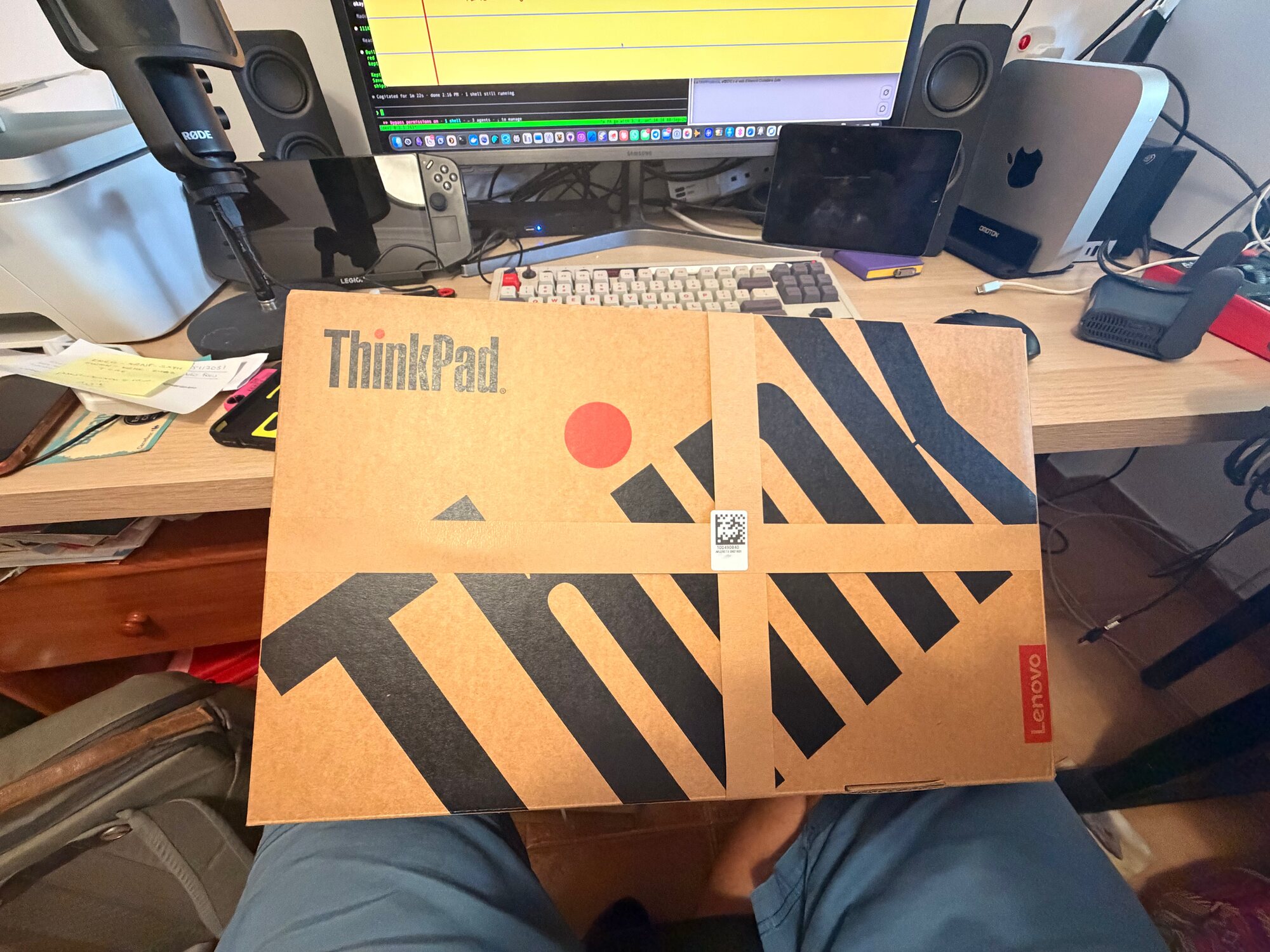
Omarchy was fast. After more than 25 years primarily using Macs, I bought a Lenovo ThinkPad and made it my daily machine. I did not expect to be buying a computer last week, let alone a PC.
The switch happened during a revealing week for Apple, which unveiled the iPhone Duo, its first foldable iPhone, with software that adapts as the device opens, closes and changes position.
Apple’s new CEO, John Ternus, said Duo shows what is possible when hardware and software are “engineered together.” By contrast, Omarchy puts the configuration, scripts and source within reach of the person using it. It feels like I am back on a computer that I have the freedom to customise.
Rebuilding Cerebro around OpenClaw
I have spent the past ten months building Cerebro, my working knowledge system. The useful patterns were there, but so was cruft that would not disappear. There had also been integration challenges, particularly around my Mac mini.
For deeper system integration—say, when you want your AI agent to work directly with system tools—you either need to be present at the Mac to authorise every tool call by clicking a button, or find a way to grant every tool the permissions it needs to access the computer. Some of these tools are updated weekly, which would mean authorising them again and again, ad nauseam. Hardly the point of having a co-operating system.
A good security model matters. But in recent years, I have felt that Apple’s warnings and security principles do more to protect Apple than the user. Case in point: needing to tap three or so times to get through an “Are you sure you want to delete this app?” dialogue.
I thought a new build and a new approach would let me preserve the working patterns in a different framework. This time I started with OpenClaw as the framework around Cerebro.
On the ThinkPad, I am rebuilding how the system works without pretending every existing workflow has already moved.
Why I chose Omarchy
Omarchy gives me fewer distractions and shiny things. My work feels more focussed.
I spend less time figuring out which app does what and how to make the pieces work together. I am also no longer running into Apple’s System Integrity Protection and sandbox rules in the same way when I want to customise the machine.
The ThinkPad also gives me something I missed: ports.
Integrated Ethernet, USB-A, USB-C and HDMI are all there. I no longer have to keep looking for something I can plug my MacBook Air into.
Linux is not new, nor is Arch Linux, which sits underneath Omarchy.
What Omarchy packages is a strong set of decisions. It began in June 2025 as David Heinemeier Hansson’s own Arch and Hyprland setup, designed to remove the hours of assembly normally required before that kind of desktop feels complete. The defaults arrive together, but they remain open to change. It is largely navigable by keyboard rather than mouse, which suits me as a long-time user of the Alfred launcher.
The project’s 40,000 GitHub stars measure interest rather than lasting adoption, but they show that its strong defaults have found an audience.
Where the operating system still bites
The move is not complete.
I am nervous about video calls and screen sharing, where I am relying on web apps instead of native ones. I miss the power tools I have built muscle memory around over the years: a custom Keyboard Maestro palette and my Stream Deck setup, for example.
I still have the Mac mini to fall back on while I adjust. I expect to adapt to these gaps over time.
These are the costs of choosing openness. Native apps and accumulated automation remain tied to the local machine, and some of mine have not followed me yet.
What the switch costs
Omarchy and Arch Linux demand more from the person using them. I am giving up some native convenience and years of accumulated automation for a system I can inspect, change and connect more freely.
Before making the same move, list the native apps, automations and hardware behaviours you would miss. That list is the real cost of switching.
The openness matters more to me now. Watch this space as I ditch my tablet and smartwatch and get back to my analogue roots. I am one step closer to having a co-operating system that works with me instead of one I have to work around.
— Jim