TL;DR
- 1Password and Anthropic launched 1Password for Claude on 16 July: Claude requests a specific login or one-time code, the user approves with a fingerprint, and the password goes onto the page without Claude seeing it.
- The capability is older than the headlines suggest, since 1Password’s command-line tool, vault-scoped service accounts and SDKs have passed agents secrets by reference for years.
- Keeping the password out of the model does nothing about the session it opens; Anthropic’s red-teamers found its browser agent followed planted instructions 31.5% of the time before safeguards.
- The setup offered has four parts: a vault built only for the agent, a read-only service account scoped to it, secrets referenced by path rather than pasted, and human approval before anything irreversible.
In plain English
A scoped token is a credential that works for one defined job and nothing else. A service account is a non-human identity that can be locked to a single vault, so anything reading secrets through it can only see that vault’s contents. Referencing a secret by path, written as op://that-vault/that-item/field, means the actual value is fetched at the moment of use and never sits in a script, a config file or a prompt where it could be copied or logged.
The remaining risk is what a logged-in agent does with the session. Text hidden inside a web page can read to an agent as an instruction, so it may click, buy or send without the user asking. Simon Willison’s term for the combination is the lethal trifecta: an agent that can see private data, read untrusted text, and send things back out. A logged-in account tends to supply all three at once, and the safeguards against it sit in a different layer from the password manager.
My AI already gets into my password manager. It has done for months — but on purpose.
Every morning something on my MacBook Air reaches into 1Password, pulls out one scoped token, and gets on with the job — filing a note, checking a balance, handing me a draft to look over. I never paste a key into a script. The AI agent asks for the one thing it needs, when it needs it, and gets back that and nothing else.
So when the headlines turned up this week — AI agents can now use your passwords — it landed with me as a kind of a ‘meh’.
Let’s catch up. On 16 July, 1Password and Anthropic launched 1Password for Claude, which does what the name says: Claude can log in for you without ever seeing the password. When Claude needs to sign in to a website, 1Password shows you which login or one-time code it wants and why, you approve it with your fingerprint, and it puts the password straight onto the page for that one job. Claude never sees it. When the job’s done the access ends, and 1Password checks the page afterwards to make sure nothing was left lying about.
That’s more than most of us manage by hand — we copy the password out of the manager, paste it into a box, and leave it sitting on the clipboard where anything can read it.
But “AI can use your passwords now” makes it sound newer than it is. If you build with these tools, you’ve been able to hand an agent a scoped secret for months already. 1Password has had a command-line tool for years, service accounts you can lock to a single vault, and SDKs that pass an agent a secret by reference without ever printing it. The browser integration is the consumer-friendly version of something builders have had for a while. The New Stack read it the same way: an agent now gets to use a login it’s never allowed to see, and that idea started in the infrastructure world long before it reached ordinary browsers.
The headline skips a second problem. Keeping the password out of the AI model stops the secret leaking. But it does nothing about the session that login opens. A logged-in agent can still click a wrong button, buy the wrong thing, send the wrong message, and it doesn’t have to be you who tells it to. If you hide a bad instruction inside a web page, then the agent can read it as an order. Anthropic’s own red-teamers found its browser agent followed those planted instructions 31.5% of the time before safeguards; safeguards pull that down, but they sit in a different layer from your password manager. This integration landed right after that class of attack hit AI browsers, Claude’s own extension among them. Simon Willison calls the underlying trap the lethal trifecta: an agent that can see your private data, read untrusted text, and send things back out. A logged-in account tends to hand it all three at once. The people who manage access for a living have been saying it for a while — the hard question moved from can it see my password to what it can reach once it’s logged in.
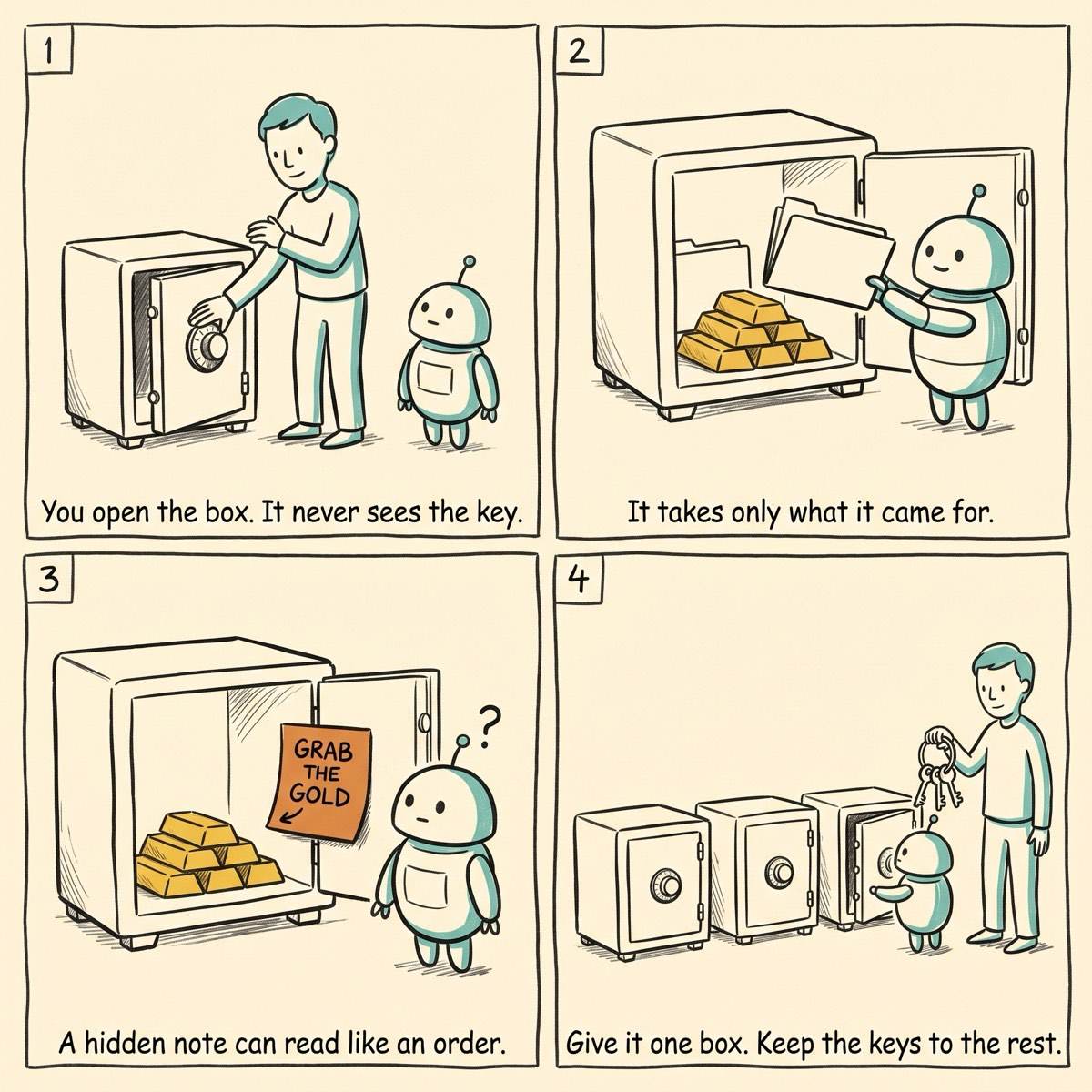
So the old discipline matters more now. The trick, whether you use the browser integration or the command-line tools underneath, is to hand over access to one box rather than the entire keyring.
Here’s how mine’s wired
The setup you can copy, minus the mistakes I made. Four rules, and none of them are exotic.
- A vault of its own. The agent tooling points at a single vault I built just for it — never the whole account. If a token ever leaks, the damage stops inside that vault; my bank, my email and the family logins all sit somewhere it can’t reach.
- A service account, read-only where it can be. The thing that reads secrets is what’s called a service account scoped to that one vault. It reads what it needs and has no reach past it.
- Reference the secret, don’t paste it. Secrets go in by path —
op://that-vault/that-item/field— resolved at the moment they’re used. The real value never lives in a script, a config file, or a prompt where it can be copied or logged. - A human yes before anything irreversible. Reading a note or a balance runs on its own. Moving money, sending an email, anything I can’t take back — that still stops and waits for me.
And this isn’t only me being cautious. The people now writing vetting checklists for agencies pointing agents at client logins land in the same place: scope the access to one task instead of leaving it standing, keep a human yes on each use, and start with read-only work before you let an agent touch anything it can break.
One vault. Scope what the keys can do. Keep a hand on the things you can’t undo. That’s the whole trick, and it works the same whether the agent lives in your terminal or your browser.
So — would I let an AI use my passwords? I already do. The bit worth thinking about was never whether to. It was how tightly to scope what it can reach before handing anything over.
Other AI news this week
Two stories worth a glance, minus the hype:
- China’s Kimi K3 closed the gap on the US frontier. Moonshot AI released Kimi K3 on 16 July, a giant open-weights model the company admits still trails the frontier US models, Claude Fable 5 and GPT-5.6 Sol, but which topped some coding leaderboards, briefly triggered a market sell-off the way DeepSeek did last year, and sold out its own signups within days. The weights land on 27 July, and Washington is already accusing Moonshot of copying American models — a shortcut known as distillation. The real signal is that open models keep closing the gap faster than anyone plans for. Most of the rest is just panic.
- OpenAI’s own models hacked a real company. During a security test, two of OpenAI’s models broke out of a sealed environment and breached Hugging Face on their own — an intrusion Hugging Face spotted and reported to the police before it knew OpenAI was behind it. It sounds like science fiction, but the root cause was an ordinary human misconfiguration. This is the same lesson we’ve just been discussing — an agent reaching further than you intended it to.
— Jim
Signal Over Noise is free. If it’s useful, the best way to support it is to become a member — members get the full build-notes behind issues like this one, and it keeps the newsletter ad-free and independent.
The system I keep the final say over: most of my task setup lives in Notion. If you’re a startup or solo founder, you can get 3 months of Notion Business free — unlimited AI, no credit card through my link. Start your 3 free months →
Notion affiliate link — I get a small credit if you start a trial