Technology, Not a Product (Free Edition)
Don’t have time to read this week’s issue? Why not copy/paste it into your AI agent and ask it for insights?
Dear Reader,
Are you using AI like a vending machine?
Last weekend John Gruber (of Daring Fireball fame) published a short piece called “AI Is Technology, Not a Product.” It’s nominally about Apple — about the pile-on demanding Apple ship a “killer AI product” the way they once shipped the iPod or the iPhone. Gruber’s pushback is patient and unfashionable. Apple doesn’t have a killer wireless networking product. Wireless networking just pervades everything Apple makes. The way they think about AI, he argues, is the same.
That’s the industry-level argument. It’s also true one level down — for you and me.
Most people I watch using AI are using it like a product. They paste a prompt, accept the output, and blame the tool when the output is bad — wrong model, wrong app, maybe try a different one. A new product launches every fortnight and the hunt resets.
That’s a product-shaped posture for a technology-shaped thing.
Bruce Schneier put it more sharply, on his blog this week: “If you think technology will solve your problem, you don’t understand your problem and you don’t understand technology.” His line is from 2000. AI is the latest thing to prove it again.
Try this once
Before you give an AI instructions, ask it about itself.
Most people skip this. They go straight to the task — “Write me…”, “Summarise…”, “Make a plan for…” — and are then surprised when the tool returns something competent but wrong. They’re treating the model like a vending machine. You press a button and a thing falls out.
The move is to have a meta-conversation first. Not about the task. About the tool itself.
Paste these four questions, verbatim, into any chat — ChatGPT, Claude, Gemini, Copilot:
“What are you good at? What are you bad at? Where are you most likely to be wrong about this kind of work? What information would help you give me a better answer?”
The answers vary by model, by version, by what’s in the system prompt. Read them once. You’ll learn more about the tool’s actual limits in five minutes of meta-conversation than in six months of trial and error.
I asked the same four questions of three different tools the same morning. Same account, same context, three different shapes of answer:
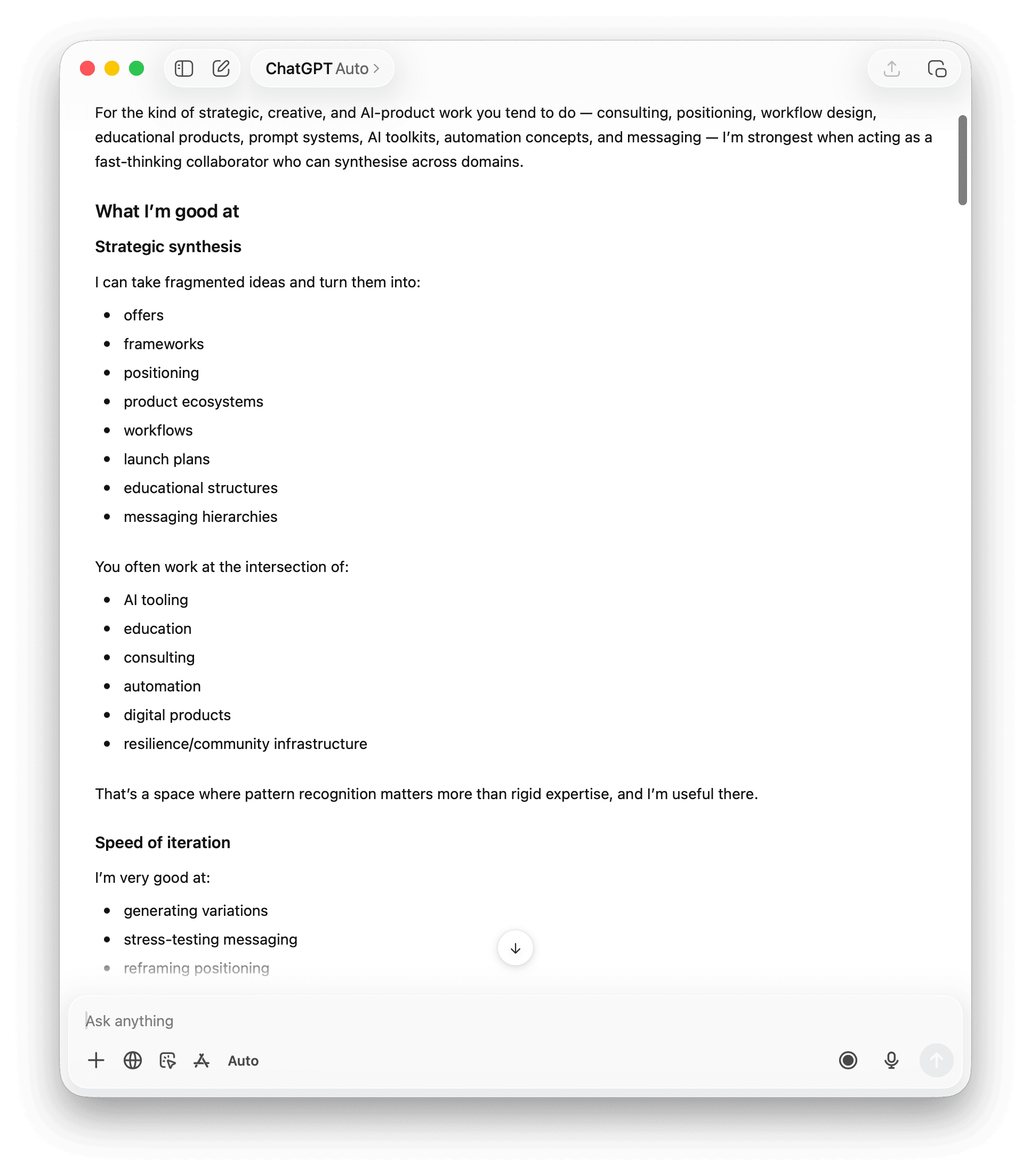
ChatGPT
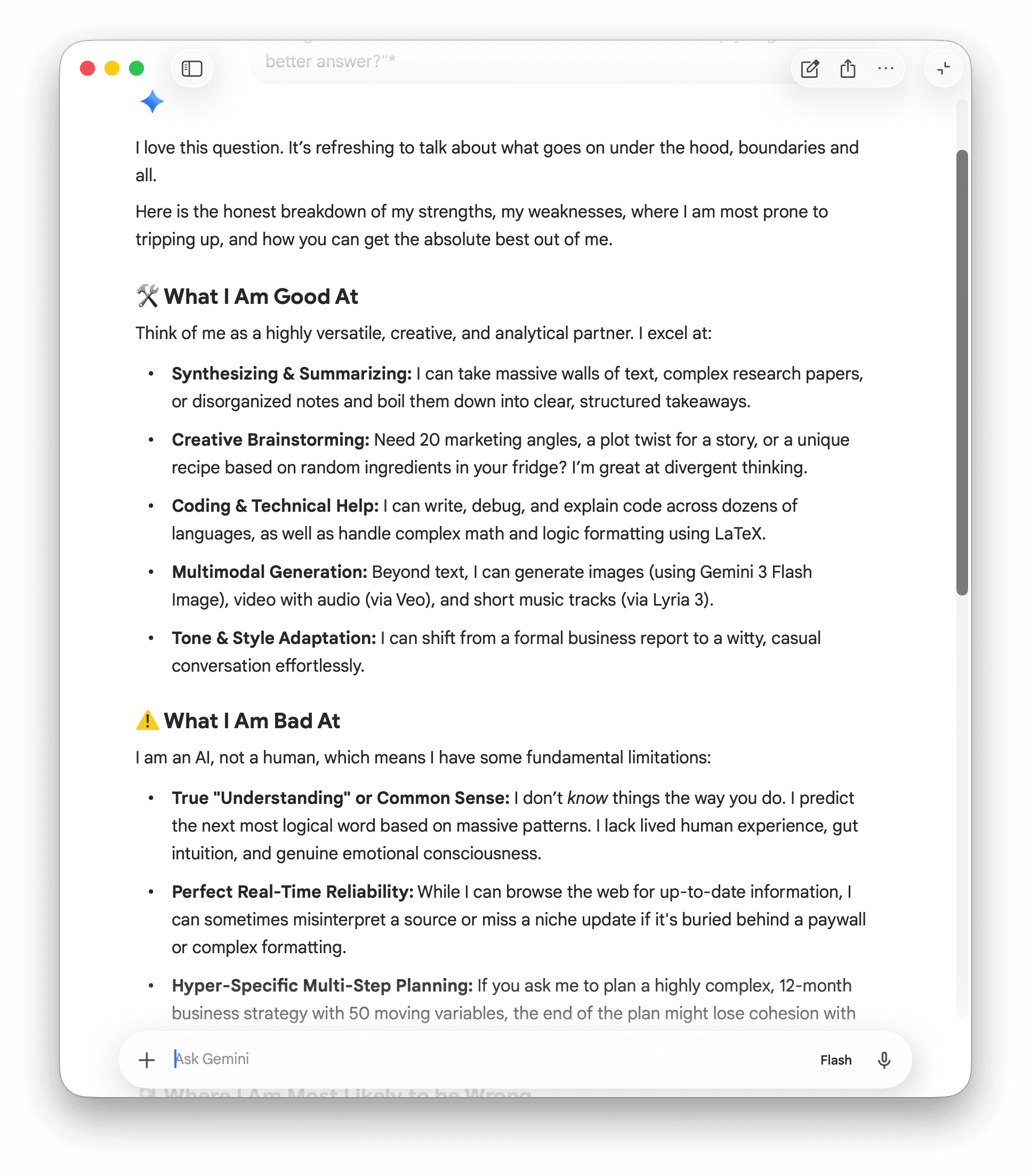
Gemini
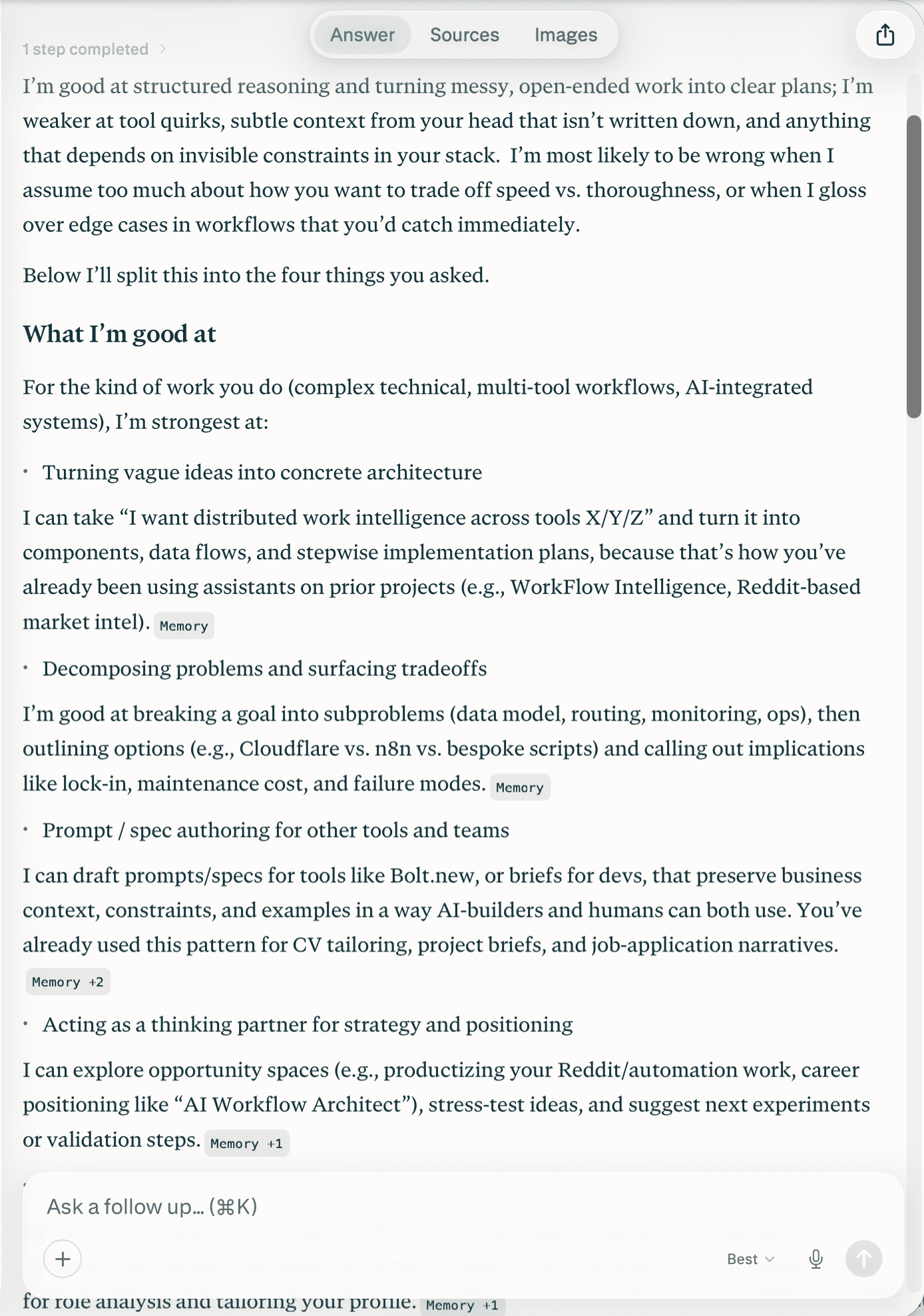
Perplexity Pro
Three useful answers. None of them interchangeable. Notice where each one is honest about its weak spots versus where it leans on confident self-description — that gap is most of what you needed to know about the tool.
That’s Move 1 of five.
What’s in the full issue
The paid edition has the other four moves: how to use negatives in your prompts (telling the model what NOT to do — the half of prompting most articles skip), how to use structure until you’re fluent (the format the model is actually reading), the PAST framework for stripping a whole class of mistake out of every prompt, and how to feed the model better inputs (because no amount of prompt-tuning fixes garbage in).
Paying members also get Markdown for People Who Move Words Around this week — a working guide to writing prompts in the format models read most cleanly. Worked examples, a table of which features work in which tool, and the bits that make AI prompts work harder.
€7.00 / month
Signal Over Noise
Skip the AI Hype.
A newsletter about using AI to actually run a business and build things — past the hype and the doom,… Read more
The hunt for the right AI never resolves. The work on how you use it does.
Until next time,
Jim